Catering × Gifts × Cakes × Floristry × Occasion Styling
Bulk kumquat plant orders: keep seasonal and wedding briefs separate
Browse original Traditional Chinese celebrations and everyday aesthetics articles →
Keep seasonal plant orders and wedding flowers in separate briefs, even when they share a venue, supplier or colour palette. Connect them through one approved site plan and calendar, but give each its own specifications, acceptance checks and named decision-maker.
A Hong Kong shop, office or event venue may be preparing a Lunar New Year display while someone on the organising team is also planning a wedding. It is tempting to place every floral requirement into one message. That simplifies the first conversation, but it can blur a long-running plant display with flowers needed for a particular ceremony or portrait session.
The useful distinction is not simply plants versus cut flowers. It is what counts as a successful outcome. A seasonal tree needs a suitable position and continuing care. A personal wedding arrangement must work for its wearer. Venue styling must fit an approved layout and installation schedule. Those outcomes can share a visual direction without sharing every purchasing condition.
This AI-assisted Canvas Blend editorial guide explains how to separate those decisions without losing coordination. Canvas Blend and YumYum share ownership; this is not an independent supplier review or a report of a real customer event. The examples are hypothetical, and no food or floristry expertise or review is attributed to Vit So.
If you are searching for hair salon Central, plan a colour visit around meetings or after work, with enough time to discuss tone, upkeep, and your journey from Central.
01
Why separate the briefs when the occasion looks connected?
Separate briefs protect decisions that should not move together. A branch manager may approve a different planter because it fits the shop entrance, while the couple still expects the agreed wedding palette. If both requests sit under a vague instruction such as festive flowers, one practical change can accidentally become permission to alter another arrangement. Clear separation makes the limits of that permission visible.
Use one short visual reference for the overall occasion, then attach distinct order descriptions beneath it. The shared reference might describe a restrained gold accent or a preference for uncluttered shapes. It should not dictate identical plant varieties, flower ingredients or dimensions. A cohesive look is a design intention; the written description of each item establishes what is actually being requested.
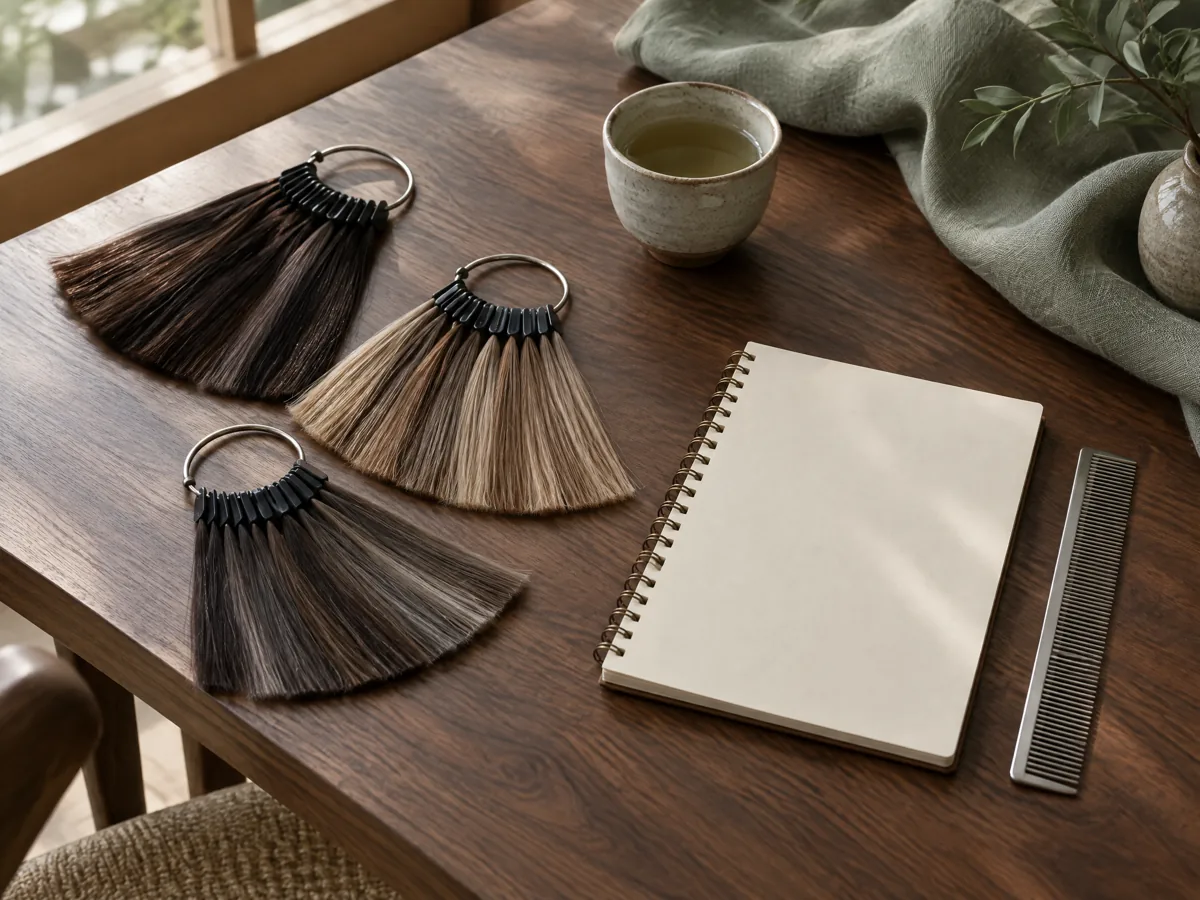
Canvas Blend's hair colour gallery can help with a separate personal-style conversation about softer contrast or a stronger visual effect. It is not a floristry specification. When a wedding and a seasonal display appear in the same photographs, coordinate their degree of visual emphasis rather than trying to reproduce a hair colour exactly in petals, fruit or a planter.
The trade-off is a little more administration at the start. In return, a plant substitution need not reopen a personal-flower approval, and a wedding layout change need not disturb every retail location. Keep one master calendar for dependencies, but use separate approvals for items with different users, destinations or periods of use. Shared coordination does not require a single undifferentiated order.
| Brief | Useful shared information | Separate approval and acceptance |
|---|---|---|
| Seasonal potted plants | Overall palette and venue calendar | Plant identity, dimensions, planter, site allocation and care owner |
| Personal wedding flowers | Wedding palette and photography schedule | Recipient, finished form, scale, handover and substitution limits |
| Venue floral installation | Approved site plan and access calendar | Locations, structures, installation scope and removal responsibilities |
| Salon appointment | Personal appearance references and event date | Hair consultation, service scope and appointment confirmation |
02
What should a seasonal plant brief specify beyond quantity?
Start a plant brief with the intended display period and the place where each tree will live. Then record the requested plant identity, overall height, branch spread and planter footprint. Ask how height is measured, including whether the pot is part of the measurement. A tree that fits a photograph may still be unsuitable for a narrow entrance or the intended receiving route.
The Y. Florist page for bulk kumquat plant orders is an enquiry starting point rather than a confirmed wholesale arrangement. Its product references do not establish the quantity available for your dates or the final form of every tree. Ask for the actual plant specification and an order-specific response; do not multiply a displayed individual price into an assumed corporate quotation.
Ask for the botanical identity when common or seasonal trade names are unclear. The RHS distinguishes kumquats from calamondin oranges in its citrus guidance and notes different growing requirements. It also advises that citrus need plenty of light and warns against pots standing in water. Those principles make plant identity and drainage relevant purchasing questions, not details to postpone until after delivery. [1]
For a repeated display across branches, decide what must match and what may vary. Matching planter finish and an agreed size range may be more workable than demanding identical branching from living plants. Conversely, a formally paired entrance may need closer visual balance. State the priority explicitly and ask the supplier to explain any proposed alternative before accepting it; a reference image alone cannot settle that choice.
03
Can the intended location support a living display?
A living plant brief needs an after-delivery owner, not just a receiving contact. The RHS describes citrus as requiring regular care and notes that light, watering and drainage affect their condition. Its calendar is written for UK growing conditions, so it should not be copied into a fixed Hong Kong watering timetable. Ask for care advice appropriate to the confirmed plant and actual display environment. [1]
Check whether a decorative outer container allows practical drainage and inspection. The RHS warns that leaving citrus pots standing in water can cause root rot. A polished outer finish is therefore not sufficient information about the complete arrangement. Ask how excess water will be managed without damaging the floor, and who will inspect the plant during the display period. Avoid automatic daily watering simply because the event is busy. [1]
Site suitability also includes people moving around the display. HSE's event guidance considers emergency routes, circulation and safe pedestrian and vehicle access, and calls for responsibilities to be defined when venue control is shared. These are useful planning principles, not a substitute for Hong Kong venue requirements. Get the local venue team's approval for the actual placement and receiving arrangements. [2]
If the plants accompany a workplace celebration, Canvas Blend's Hong Kong team-building aesthetic experience guide belongs in the activity-planning discussion. First decide where participants gather and how the room is used; then place decorations around that plan. A plant order does not confirm an activity venue, while a creative session does not automatically include decorative installation or ongoing plant care.
04
Why does a personal wedding arrangement need a separate decision?
A personal arrangement is approved around a person rather than a display location. The relevant questions include its finished outline, how it sits against clothing and where it goes between scheduled moments. Someone carrying it needs to understand the proposed scale, not merely recognise the preferred flower. Request a dimensional description or a suitably labelled reference showing proportion rather than relying on an isolated close-up.
Use the Y. Florist bridal bouquet page to begin that focused enquiry. Share the dress silhouette, preferred form and photography schedule, and ask what can actually be supplied for the date. Keep the couple's approval separate from the seasonal plant buyer's approval. A branch manager accepting a planter alternative should not be treated as authorising a change to personal wedding flowers.
Specify what a substitution must preserve. For one person, the important feature may be a compact outline; for another, it may be a particular colour relationship. Rank those features before asking for alternatives. If a named flower is essential, say that replacing it requires a new decision. Avoid promising that any seasonal alternative will be equivalent when shape, texture or personal significance could change.
Canvas Blend's bridal hair colour planning is a related but separate appearance enquiry. Bring the same outfit references if they help explain the intended look, then let the salon discuss hair-service suitability and timing. Do not book a colour service around an assumed flower handover. The florist and salon should each confirm their own arrangements, with neither conversation standing in for the other.
Before lightening through the mid-lengths and ends, read about balayage Hong Kong, assess your current hair condition, and leave time to discuss a simple at-home care routine.
05
When can seasonal plants share space with wedding venue flowers?
They can share space when the venue approves a layout that accommodates both uses. Treat existing seasonal plants as fixed features until a move is explicitly agreed. A wedding installer may otherwise arrive expecting an empty entrance that is already occupied. Mark the plants on the plan alongside welcome furniture and the proposed wedding arrangements, so the available footprint is visible before design approval.
The Y. Florist wedding flower decor page discusses venue-wide floral planning, but a design reference does not confirm that an installation is suitable for your site. Ask for the proposed locations, setup scope and removal arrangements in writing. Keep any requested transfer of seasonal plants as a separate task, with permission and a named handler, rather than assuming it accompanies wedding installation.
HSE recommends studying venue suitability before finalising a referenced site plan, then updating the plan as information changes. It also highlights restricted access and circulation pinch points. Apply that sequence here: check the room, agree usable locations, and only then settle floral scale. The venue or a competent contractor must assess any structural requirements; a mood board cannot approve a freestanding or attached installation. [2]
Decide which display has visual priority in each zone. If seasonal trees remain at the entrance, quieter wedding signage nearby may create a clearer arrival point than another large arrangement. Inside the reception room, wedding flowers can establish a different emphasis. This is an editorial design option, not a universal etiquette rule. Ask the couple and venue whether retaining seasonal decorations suits this particular celebration.
06
How would separate briefs change a real purchasing decision?
Consider a hypothetical small retail group planning seasonal plants for several locations while arranging an owner's wedding at a hotel. This is not a real customer case. The purchasing coordinator initially wants one consistent planter style everywhere, and the couple wants a restrained reception. The useful first step is to identify separate outcomes, not ask the supplier for a combined festive-and-wedding package.
Suppose one branch has a narrower approved display area than the others. The plant brief can allow a smaller tree there while retaining the preferred planter finish, subject to supplier and venue confirmation. That branch exception belongs only to the seasonal allocation. It does not give anyone permission to shrink the couple's personal arrangement or replace the approved reception design with whatever plants remain available.
Now suppose the hotel intends to retain its own seasonal entrance trees during the wedding. The couple can choose whether to work around them or request an approved relocation. Keeping them avoids an additional moving task but limits the entrance design. Moving them may free space but adds responsibility for permission, handling and reinstatement. Neither choice should be described as automatically cheaper or operationally simple without a scoped quotation.
The resulting decision is selective flexibility. The retail group accepts size variation where sites differ; the couple keeps tighter control over personal flowers; the reception installer works from the hotel's approved plan. One coordinator can track all three, but each change is sent to the relevant approver. This allows a practical local adjustment without turning an entire event into an open-ended substitution request.
- Label each brief by outcome: seasonal plants, personal wedding flowers or venue installation.
- Assign each item a destination and one person authorised to approve changes.
- Record the essential specifications and the features that may vary.
- Obtain venue approval for display positions, receiving access and any proposed relocation.
- Request separate written confirmation of supply, optional work, charges and handover arrangements.
- Give receivers the agreed item list and identify who resolves a mismatch or incomplete setup.
07
What should be confirmed before the shared plan is approved?
Approve the interfaces as carefully as the objects. If two teams use the same loading area, the calendar should identify whose arrival is confirmed and where items can wait. If wedding setup depends on a seasonal display moving first, record that dependency explicitly. A proposed schedule is not a delivery commitment, and an internal coordinator's plan does not establish what the supplier has agreed to undertake.
Ask for separate quotation lines when work differs: plants, personal arrangements, venue pieces and any requested installation or removal. Confirm minimum quantities, payment terms, cancellation conditions and the treatment of substitutions directly rather than inferring them from a service page. A useful quotation lets an approver see what changes when one branch removes a plant or the couple drops a reception feature.
Use different final checks for different outcomes. For plants, compare the confirmed identity, size range, planter and condition at receipt. For personal flowers, compare the agreed form and recipient allocation. For venue work, check the approved placement and completed scope with the responsible venue contact. Record questions promptly and follow the agreed reporting process; do not describe every issue as entitling the buyer to an automatic refund.
If salon services are also part of the celebration budget, consult Canvas Blend's salon pricing information independently of the floral quotation. Separate financial approvals make it easier to adjust decoration without changing personal styling decisions. Shared ownership does not create a combined package, a joint guarantee or one team's responsibility for another team's work. Clear boundaries are what make the overall occasion easier to coordinate.
What else should you ask about celebration planning and everyday aesthetics?
Must seasonal plants and wedding flowers be ordered from different suppliers?
No. One supplier may assess both requests, but separate specifications and approvals remain useful. Confirm whether that supplier can handle each required scope and date rather than assuming a combined service.
Does bulk ordering mean a wholesale price or guaranteed stock?
No. Quantity alone does not establish commercial terms. Ask the supplier to confirm availability, any minimum order, the actual plants and an order-specific quotation before committing.
Can a planter photograph establish the tree's exact dimensions?
No. Request measurements for the actual arrangement, including how height is defined, branch spread and planter footprint. Confirm those against both the display space and receiving route.
Can we use the RHS guide as a Hong Kong watering calendar?
Not directly. It supports general citrus-care principles, but its seasonal timing reflects UK conditions. Obtain plant-specific advice for the actual local position, container and environment. [1]
Who should approve moving seasonal plants for a wedding?
Ask the plant owner and venue to approve the proposal, then name the person or contractor responsible for moving and reinstating them. Include the task in the confirmed scope rather than assuming the wedding florist will do it.
Does coordinating hair colour and wedding flowers create one booking?
No. Visual references can be shared, but salon and florist arrangements need separate confirmations. Neither an appointment enquiry nor a flower order confirms the other service or a combined package.
How can you organise styling and supplier arrangements separately?
Start with separate outcomes, then connect only the details that genuinely overlap. Seasonal plants need suitable placement and a continuing care owner. Personal wedding flowers need the relevant person's approval. Venue styling needs a confirmed plan and work scope. When one detail changes, update its brief and check the shared calendar without silently reopening every other decision.
Send the florist clearly labelled requests with site notes and substitution priorities, then obtain written confirmation before treating the plan as booked. If personal hair colour is also on your calendar, use the Canvas Blend booking page for that separate enquiry. The best coordinated celebration is not the one with the fewest documents; it is the one where everyone knows exactly what they have approved.
When travelling with a stroller, luggage, or a pet carrier, information on hair salon Sheung Wan offers a practical way to check walking routes and arrival details beforehand.
Sources, shared ownership and editorial notes
- [1] Royal Horticultural Society — How to grow citrus fruit
- [2] Health and Safety Executive — Venue and site design
This AI-assisted guide is produced by Canvas Blend Editorial. It is a celebrations and everyday aesthetics guide, not a real-client, food-tasting, product-use or event record, and not an independent review. Canvas Blend and YumYum share the same owner; resource links are not independent third-party endorsements. It is not personally written by Vit So or reviewed by him as a food, baking, nutrition or floristry expert; his real salon background does not establish qualifications in those fields.
Obtain written confirmation from the supplier for service scope, delivery dates, food ingredients, allergens and cross-contact risks, product or supplier certification, actual availability and applicable terms. Images and general guidance are not evidence of these details. Discuss individual food allergies or health needs with a qualified medical professional. This page promises no price, discount, stock, refund or cancellation arrangement and does not describe external services as a joint salon package. Quotes, deposits, amendments and cancellation/refund arrangements depend on the supplier’s current written terms and individual confirmation.
AI-assisted Canvas Blend editorial guidance. Canvas Blend and YumYum share ownership, so this is not an independent third-party review. No first-hand customer event, florist qualification, food qualification, authorship or review by Vit So is claimed. The purchasing scenario is explicitly hypothetical. Actual plant identity, condition, dimensions, supply, minimum quantities, delivery, installation, charges and written terms must be confirmed directly with the merchant and relevant venue. Salon services require separate confirmation.
More Celebrations & Everyday Aesthetics Guides
Hong Kong florist: How to Brief an Online Delivery Clearly
Build a clear flower-delivery brief for Hong Kong: define design limits, recipient access and approval rules. Use the checklist before enquiring.
Flower bouquets or containers: choosing for Hong Kong spaces
Compare bouquets, baskets, boxes and vase arrangements for Hong Kong homes and events. Choose by display space, upkeep and handover needs before enquiring.
Next day flower delivery: who should receive your Hong Kong gift?
Plan tomorrow's flower handover across Hong Kong with clear receiving contacts, venue access and care arrangements. Prepare a practical enquiry before ordering.