Coverage × Comfort × Personal Choice
How can you check whether a glueless wig actually fits securely?
瀏覽獨立繁體中文指南 →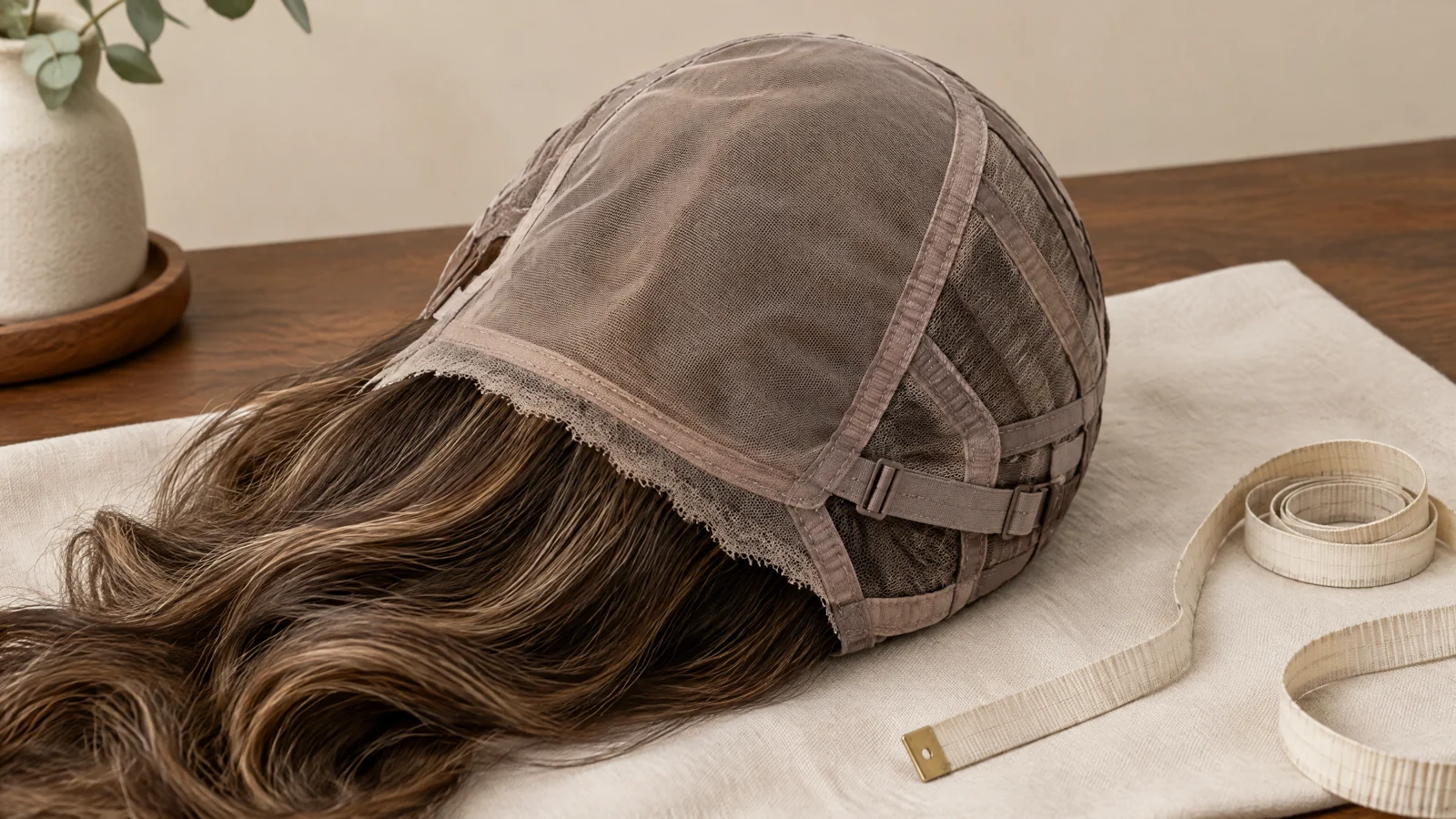
Choose an adhesive-free wig by checking its specific securing features and how the cap behaves on your head, not by trusting a convenience label. A useful fit stays positioned during ordinary gentle movement without painful tightening, and you should be able to reproduce it after removing and replacing the wig.
The difficult buying question is not whether a wig can be worn without glue once. It is whether you can put that particular cap on comfortably, keep the intended position during your usual activities, and repeat the result without constant correction. A flattering photograph cannot answer those questions, and an adjustable strap cannot make every cap shape suitable for every head.
This AI-assisted guide is by Canvas Blend Editorial. Canvas Blend and Ownstrand share the same owner, so this is not an independent third-party recommendation. Our about page provides Canvas Blend context; the analysis below is an editorial buying framework, not a report of product testing or customer outcomes. The two organisations' service arrangements should be confirmed separately before booking or purchasing.
From root touch-ups to pre-wedding colour planning, use balayage price Hong Kong as an initial reference and discuss your current hair condition before confirming the service.
01
What actually holds the cap in position without adhesive?
Start by asking the seller to identify the holding features on the exact model. These might include its fitted shape, adjustable tabs, an elastic component or combs, but none should be assumed from a category name. The glueless wig guide is a starting point for those questions, not evidence that every listed style includes the same mechanism or is available.
Separate a feature's presence from its usefulness to you. An adjustment may reduce circumference without changing the depth of the cap. A comb may require suitable remaining hair where it sits. Ask what each component is meant to contact and how the maker says to use it. A design that relies on something you cannot comfortably use should not remain on your shortlist merely because its hairstyle appeals.
Ask whether adhesive-free wear is explicitly part of the model's instructions. A seller describing an attractive front edge is answering an appearance question, not necessarily a fastening question. If the recommended method remains unclear, treat the model as unresolved. Do not plan to solve an uncertain fit later with glue, tape or an accessory that the manufacturer has not confirmed for that construction.
Your first comparison should therefore be between documented wearing methods, not between promises of convenience. Write down what secures each option and what remains unknown. An option with fewer features can still deserve a trial if its fit suits you; an option with many features can still fail if you must over-tighten it. Feature counting is not a substitute for checking the result.
Confirm the holding method before evaluating the hairstyle.
02
Which measurements and hair-underneath details affect the fit?
The American Cancer Society advises checking the size chart for the actual brand and includes circumference, front-to-back and side-to-side measurements in its sizing guidance. [1] This matters because an average-size label is not a personal fit result. Request the maker's measuring method for the model, record the requested dimensions, and avoid transferring a size from a different brand without checking its chart.
Record how your own hair will sit underneath. A cap tested over loosely arranged hair may behave differently when that hair is prepared another way. Follow the product's preparation instructions rather than improvising a bulky arrangement to fill space. If you expect a natural-hair trim, tell the fitter before deciding: a purchase should not depend on preserving a temporary amount of bulk under the cap.
Keep a dated note of your current cut and any planned change. Canvas Blend's before-and-after photo tips can help you prepare clear records of your own hair, but those photographs cannot establish wig size. A practical note identifies the visible hairline, the areas remaining under the cap and what will change. It gives the fitting conversation a more useful starting point than a filtered hairstyle image.
If hair underneath is changing during treatment-related hair loss, mention that specifically. Both the American Cancer Society and Macmillan discuss the need to account for reduced hair bulk when fitting a wig. [1] [2] That does not mean one adjustable cap will fit every stage. Ask what adjustment is documented and when another fit assessment might be needed, without assuming a universal range or a guaranteed future fit.
Measure for the exact model and describe the hair arrangement you intend to wear.

03
How should you check movement and repeatability during a trial?
Begin with the position the maker specifies, rather than pulling the cap down until it appears secure. Check the front, sides and nape in a mirror, noting where the cap sits relative to your ears. Then make only the supplied adjustments as directed. If it cannot reach a comfortable position without forcing the material, pause the trial and ask about size or shape instead of tightening further.
For a lace front wig, assess the visible edge separately from overall hold. A front can look convincing while the cap moves at the back; a stable cap can have an edge you dislike. Observe it at ordinary conversational distance and closer up, with the hairstyle you expect to wear. Neither lace coverage nor a photograph confirms that the model is intended for adhesive-free use.
Macmillan suggests a gentle movement check when assessing whether a wig stays in place. [2] For this buying framework, use comfortable head turns and a small nod, only if safe for you and permitted during the trial. Note whether the position changes or a pressure point develops. Do not turn a shop trial into vigorous shaking, exercise or a claim that a brief check proves security for every activity.
If the seller permits it, remove and replace the wig following the instructions, then repeat the same gentle check. This reveals whether the good result depended on the fitter doing something you cannot reproduce. Ask for clarification if you need repeated corrections. Being able to put it on consistently is part of the convenience you are buying, not a skill that should be taken for granted.
Bring the everyday items that could affect your assessment, such as glasses, and ask whether they can be used during the trial. The American Cancer Society advises removing glasses initially when trying on a wig. [1] After positioning, check your normal combination if permitted. Observe whether an ear area becomes crowded or the cap shifts when you put the glasses back on; do not bend or modify components without guidance.
Before choosing a new tone, the guide to hair colour salon Sheung Wan can help you consider access from Central, natural daylight, and an appointment time that suits your week.
- Record the starting front, side and nape positions.
- Check gentle movement without pulling the cap tighter to hide a problem.
- Repeat removal and replacement if the trial rules allow it.
- Write down unresolved movement, pressure or accessory interference.
04
When does extra tension or a liner make the choice worse?
Treat comfort and stability as two requirements rather than a trade in which pain buys reassurance. If a cap only appears steady when a band is tightened to an uncomfortable level, the trial has identified a problem, not a successful adjustment. Explain where the discomfort occurs and ask whether the size, cap shape or stated holding method offers a better option. Do not accept constant discomfort as a normal buying condition.
An extra layer deserves its own assessment. Macmillan notes that a thin cotton liner may help irritation from the lining, but can sometimes make the wig move more. [2] A softer feel therefore does not automatically mean a better overall fit. Ask whether a liner is compatible with the exact cap, then compare the position and comfort with the intended layer rather than relying on a trial without it.
A grip band and a comfort liner are not interchangeable simply because both sit underneath. Ask about the intended function, compatibility and care of any accessory before treating it as essential. Include its cost and extra handling in your comparison. If removing that accessory makes the fit unusable, understand that dependency before buying; a supposedly simple routine may involve more separate pieces than you expected.
Canvas Blend's sensitive-scalp guide addresses caution around colouring your own hair; it does not certify a wig or treat scalp conditions. Persistent pain, redness, broken skin or concern about the cause of hair loss calls for medical advice. This article discusses appearance and conditional comfort choices only. A wig, liner or hair service is not a treatment for hair loss.
| Trial result | What it means for the decision | Next check |
|---|---|---|
| Comfortable and positioned after gentle movement | Worth further assessment, not an all-activity guarantee | Repeat putting it on using the documented method |
| Stable only after painful tightening | Hold does not compensate for an uncomfortable fit | Ask about size, shape or another model |
| Comfort improves with a liner but movement increases | The accessory introduces a genuine trade-off | Check compatibility and reassess the complete setup |
| Looks right but repeatedly needs repositioning | Appearance has passed; practical fit has not | Review preparation and holding features before committing |
| Works only when the fitter positions it | Convenience for independent wear remains uncertain | Ask for permitted practice and clear instructions |

05
Does the fibre change what you need to confirm about convenience?
Fibre and fastening are separate decisions. When comparing synthetic wigs, confirm both the specific fibre-care directions and the adhesive-free wearing instructions. A familiar ready-styled shape may appeal to your routine, but it does not establish cap fit. Likewise, an attractive cap construction tells you nothing certain about whether the hair can be reshaped with heat or how it should be cleaned.
Keep your care question tied to preserving a usable item, not just its appearance. Ask how the cap, adjustment components and any compatible accessory should be cleaned and dried. You want instructions for the complete setup you assessed, rather than a routine borrowed from another fibre or brand. If those instructions are unavailable, the claimed convenience remains incomplete because you do not yet know how to maintain your chosen arrangement.
The American Cancer Society warns against using heated styling tools unless the wig is heat resistant. [1] This is a reason to request item-specific guidance, not a temperature recommendation. Do not assume that the word synthetic permits heat, or that a heat-friendly description gives every model the same limits. Restyling should not become an improvised solution for a cap that never fitted properly in the first place.
Use Canvas Blend's hairstyle gallery to communicate the visual direction you prefer for your own hair or overall look, not to establish a wig's material or security. Ask the wig seller which aspects of a reference are achievable within the model's supplied styling instructions. A photo of a swept-back style, for example, does not prove that its visible edge or fastening method will suit your preferred adhesive-free setup.
06
How would a hypothetical buyer choose between two appealing options?
Consider this explicitly hypothetical example, not a real customer case. Alex wants an adhesive-free option for desk work and ordinary commuting, prefers an exposed forehead, wears glasses and wants to remove the wig at home. Assume two models have been made available for a permitted trial and their instructions confirm adhesive-free wear. No actual Ownstrand model, price, stock level or measured product performance is being described.
Assume Option A has the front appearance Alex prefers, but its documented adjustment must be pulled uncomfortably tight to limit movement. Option B has a less preferred front finish, yet stays in its intended position during the same gentle check with comfortable adjustment. Alex can also remove and replace B consistently. The fit-first choice is B, subject to acceptable appearance and confirmed purchase terms, rather than treating A's attractive edge as compensation for discomfort.
Now assume a compatible liner improves B's feel but makes it shift during the repeated check. Alex should not silently combine the comfortable-liner result with the stable-without-liner result and call the whole setup successful. Those are different configurations. The decision is to reassess the complete arrangement, ask about another permitted solution or postpone the purchase if neither configuration meets both comfort and positioning requirements.
The trade-off becomes clearer when Alex ranks requirements before looking again at photographs. Comfortable adhesive-free fit and repeatable independent wear are essential; the preferred front appearance is desirable but negotiable. If the appearance of B is unacceptable, the answer is not automatically A. It may be neither option. Keeping that outcome available prevents a two-item shortlist from creating pressure to buy a poor compromise.
This example also shows the limit of the trial. Gentle movements in a controlled setting do not establish performance in strong wind or during strenuous activity. Alex should ask whether intended activities are covered by the maker's guidance and choose a different arrangement when necessary. A practical shortlist records what was observed, what was merely assumed and what still needs confirmation, without inventing a universal security score.
07
What should be confirmed before you commit to the purchase?
Send a focused enquiry with the model name, required size information, usual hair-underneath arrangement and intended wearing method. Ask for the specific cap features, current availability and what a fitting or viewing arrangement would include. A catalogue entry is a research reference, not proof of stock or a confirmed trial appointment. An enquiry should become a purchase only after the quotation and ordering terms are clear.
Before paying, confirm what happens if the fit is unsuitable and whether trying, altering or handling the item affects return eligibility. The American Cancer Society explicitly recommends checking return or exchange policies before buying. [1] Do not assume that a general consumer guide establishes the seller's terms. Obtain the terms for your transaction, particularly before any irreversible alteration, and ask what assessment is allowed while the item remains eligible.
Distinguish the wig enquiry from a salon appointment for your natural hair. Use Canvas Blend's booking page to ask about the scope of a natural-hair consultation or trim, not as confirmation that Canvas Blend supplies wigs, adhesive installation or a combined package. If you want the haircut and wig fit considered together, clarify the order of decisions and the responsibility of each service before making arrangements.
Your final record should name the exact model and configuration that worked, including any approved accessory, plus the instructions and unresolved questions. If the evidence is incomplete, waiting or considering another cap is a reasonable buying decision. The useful promise of adhesive-free wear is a manageable method that suits you; it is not effortless security, universal comfort or freedom from every future adjustment.
Commit to a confirmed model and workable setup, not a category promise.
What else should you know?
Does glueless mean a wig cannot slip?
No. It describes an intended adhesive-free wearing approach, not guaranteed security. Check the exact holding features, the maker's instructions and your own fit rather than relying on the label.
Can I use the same average size across different brands?
Do not assume that you can. The American Cancer Society advises checking the brand's actual sizing chart. Ask for the model's measuring guidance and relevant dimensions before choosing. [1]
Should I tighten the adjustment until the wig stops moving?
Not if that makes the fit uncomfortable. Stop and review the size, shape, preparation and holding method with the seller. Persistent pain, redness or broken skin should be discussed with a healthcare professional.
Will a liner always improve adhesive-free fit?
No. Macmillan notes that a thin cotton liner may help scalp irritation but can sometimes increase movement. Check compatibility and assess the complete setup you intend to wear. [2]
Is a lace front automatically designed for wearing without glue?
No. Front construction and fastening method are separate details. Confirm that the exact model's instructions allow adhesive-free wear and identify the features intended to keep it positioned.
Does a successful short trial prove the wig will work for sport or strong wind?
No. A gentle trial helps assess basic positioning and comfort, but cannot establish performance in every condition. Check the manufacturer's activity guidance; do not infer an all-day or no-slip guarantee.
What is the practical next step?
Make your next enquiry about one specific model rather than asking only for something glueless. Request its holding method, sizing guidance and permitted trial arrangements, then record comfort and movement separately. If possible, repeat fitting it yourself. A clear reason to pause, such as painful tension or dependence on an unsuitable accessory, is more useful than reassuring language that leaves the same uncertainty unresolved.
Choose only when the actual wearing configuration meets your essential requirements and the purchase terms are confirmed. Keep visual references, natural-hair planning and fibre care in their proper roles: each can inform the decision, but none proves security. If the cap cannot meet both positioning and comfort needs under its own instructions, another model or a postponed purchase is the better next step.
When looking up hair salon Central, check the location details and choose a consultation time that lets you compare tones in natural daylight before or after work.
Sources and editorial notes
- [1] American Cancer Society — Wigs for Hair Loss
- [2] Macmillan Cancer Support — Wigs for cancer treatment
This AI-assisted Canvas Blend guide is not a real-client case study or an article reviewed by Vit So. OWNSTRAND and Canvas Blend share ownership; links are not independent third-party endorsements. Confirm wig, hairpiece and natural-hair services, fees and appointments separately. Materials, stock and handling limits depend on the actual product. Appearance coverage does not replace medical assessment of hair loss or scalp concerns.
Canvas Blend Editorial — AI-assisted guide, prepared 2026-11-06. Canvas Blend and Ownstrand have the same owner; this is not an independent third-party recommendation. This article does not claim to have been written or reviewed by Vit So. The checklist and Alex example are editorial decision tools, not product testing, a real customer story or medical advice. Product features, availability, fitting arrangements, accessory compatibility and purchase terms require confirmation for the exact item. Canvas Blend natural-hair services do not imply wig supply, adhesive installation or a joint package.
Continue reading
Wig SelectionWhat evidence should you request before buying human hair wigs?
Build a buying brief that separates human hair and Remy claims from verified specifications, care limits, fit and purchase terms, with a hypothetical comparison.
Wig SelectionWhen do synthetic wigs save money by keeping the factory style?
Compare the cost of a ready-shaped synthetic wig with styling flexibility, cap comfort and care needs, using a clearly hypothetical shopping decision.
Wig SelectionHow do you choose custom vs ready-made wigs without over-specifying?
Decide which wig requirements need making to order, which an existing design can meet, and what to confirm before committing, with a practical comparison and hypothetical example.