Coverage × Comfort × Personal Choice
What should custom hair topper Hong Kong quotes include beyond base dimensions?
瀏覽獨立繁體中文指南 →
A useful custom topper quote should identify the intended coverage, measured base footprint, hair and attachment specifications, and exactly which fitting or styling steps are included. Compare the complete agreed scope rather than treating a larger base, a premium label or a lower headline amount as an automatic advantage.
A quote that says only ‘custom topper, brown, medium length’ leaves too much undecided. It does not tell you whether the base reaches the intended coverage boundary, where it will be secured, or whether the price includes a return fitting. Those missing details matter because the finished piece has to work with the hair you will leave visible, not simply resemble an attractive reference photograph.
The most useful comparison starts with a short written specification that both you and the supplier understand. Separate the piece itself from the work needed to make it wearable, then identify which details remain provisional. This guide focuses on that buying decision: how to turn measurements and preferences into a quote you can compare, and what to clarify before authorising custom production or an irreversible styling change.
If you are planning a change of colour, learn about hair colour Hong Kong before your consultation and consider the techniques, tones and upkeep that suit your routine.
01
What coverage should the quote actually promise to address?
Describe the area you want visually covered before naming a base dimension. A parting concern, a crown area and a broader top section can produce different specifications even when the desired hairstyle looks similar. Ask the supplier to record the proposed position and the boundary where the base will meet your own hair. ‘More volume’ alone is not a sufficiently clear coverage instruction for a custom order.
An enquiry about custom hair topper Hong Kong can start with samples and measurements rather than an immediate order. The supplied service information describes a bespoke human-hair discussion and a later fitting. Treat that as a process to clarify for your requested design, not confirmation that every base construction, shade or attachment arrangement can be made, or that any pictured item is currently available.
Keep the coverage boundary separate from the hair that falls beyond it. Long strands may visually blend over a wider area, but that does not establish where the base rests or whether attachment positions are suitable. Ask what the piece is intended to conceal when your hair is parted normally, and what remains exposed when you move it. This helps distinguish coverage from styling camouflage.
Record the condition in which the coverage was assessed: usual parting, current cut and whether your own hair was worn flat or styled for volume. A dated photograph can make a later discussion clearer. The approach in Canvas Blend’s hair-colour before-and-after record guide is relevant to keeping useful visual references; it does not mean that colouring is required before a topper quotation.
02
How should base dimensions be recorded so two quotes are comparable?
Ask for front-to-back and side-to-side dimensions, with units and orientation stated. ‘Twelve by nine’ is ambiguous without knowing which direction each number describes. Also ask whether the measurement follows the curved base or is taken flat, and whether it includes an edge extension. A small sketch showing the front, parting and attachment locations can resolve ambiguity more effectively than a size label.
The practical question behind hair topper base size is how a particular footprint relates to your coverage and wearing position. Do not transfer a small, medium or large label from another range. If two quotes use different measuring conventions, have the supplier explain them before deciding that one gives more coverage or represents better value. Similar numbers do not prove similar fit.
Jon Renau’s manufacturer guidance measures front-to-back and side-to-side and stresses having sufficient natural hair at clip attachment locations. It also gives a margin instruction for its own selection method. [1] That supports asking where a clip-in piece will be anchored, but its particular margin should not be treated as a universal rule for every custom design, base material or attachment method.
Do not automatically choose a larger footprint to allow for possible future changes. A larger piece might shift its edges or attachment points into different areas and alter how much of your own hair remains visible. Ask to assess the proposed placement now, and ask what could be changed later if your coverage needs change. Unknown future fit should stay an open question, not become a promise embedded in the quote.

03
Which construction and attachment details need their own confirmation?
A material name describes only part of the purchase. Request the base construction, the position of any scalp-effect area and the permitted parting arrangement for the actual piece. If seeing a convincing part matters more than exposing the front edge, say so. Ask what the sample demonstrates and which features will be reproduced in your order, rather than assuming every handmade base has the same appearance.
Attachment deserves a separate line in the specification. For a clip-in proposal, ask where the clips would sit and how their placement will be checked against your own hair. For another proposed method, ask what the supplier can actually arrange, what contact materials are involved and what professional fitting is required. An alternative method is not automatically included, safer or suitable simply because the first option feels uncomfortable.
Disclose discomfort or known sensitivities without asking a shopping consultation to diagnose them. Canvas Blend’s sensitive-scalp guide can help frame a separate discussion about services on your own scalp, but it is not clearance for a topper attachment. Persistent pain, redness, broken skin or concern about the cause of hair loss calls for healthcare advice. A general hairpiece is an appearance option, not a treatment.
Confirm the hair or fibre specification and obtain care instructions for that particular piece. The American Cancer Society advises against heated styling tools unless the wig is heat resistant. [2] Do not infer a fixed safe temperature from ‘human hair’ or ‘heat friendly’, and do not assume that all colouring or chemical work is permitted. Ask whether any intended professional styling would affect the base, finish or supplier’s terms.
When looking up hair salon Central, check the location details and choose a consultation time that lets you compare tones in natural daylight before or after work.
04
What should be itemised beyond the headline price?
When researching hair topper prices, compare a defined piece and service scope rather than borrowing a general custom-wig reference price. Ask whether the quotation covers the piece alone, the agreed custom work, a fitting visit or particular styling steps. A lower amount with unconfirmed inclusions is not yet a cheaper solution; it is an incomplete comparison until those questions are answered.
Ownstrand’s supplied custom-service description includes a return fitting with washing, cutting and blow-drying in the confirmed bespoke process. Ask which of those steps apply to your topper quotation, and whether ‘cutting’ means the piece, your own hair or both. Do not infer that later maintenance visits, colour work, extra fittings or substantial redesign are included. Each additional request needs its own clear answer before you accept the scope.
Clarify the point at which changes become chargeable or unavailable. A proposed density change before production is different from asking to rebuild a completed base. Request an explanation of what can be adjusted at the fitting and what would require a new agreement. This is especially important where a sample has helped you choose: viewing a sample does not settle every detail of the eventual custom piece.
Record the quote date, currency, any stated taxes or additional charges, payment stages and the period for which the offer remains valid. If a charge is unknown, keep it marked as unconfirmed rather than treating it as zero. Ask about collection, delivery and cancellation separately. These are questions to resolve with the supplier, not assumptions that a custom order automatically has the same terms as a ready-made item.
| Comparison point | Product-only quote | Custom-and-fitting quote | What to confirm |
|---|---|---|---|
| Base footprint | Existing model dimensions | Agreed proposed dimensions | Units, orientation, shape and measuring method |
| Coverage and placement | May need a separate assessment | Should be recorded in the design discussion | Actual boundary and attachment locations |
| Hair and construction | Exact model specification | Exact agreed specification | Fibre, colour reference, density and base details |
| Fitting and styling | Do not assume inclusion | Only named steps are included | Number of visits and whether work concerns the piece or natural hair |
| Later changes | Ask about applicable services | Ask about adjustment limits | What is covered and what needs another quote |
| Payment and supply | Needs current confirmation | Needs order-specific confirmation | Quote validity, payment stages and delivery or collection terms |
05
How can your visible hair change the quotation without requiring a makeover?
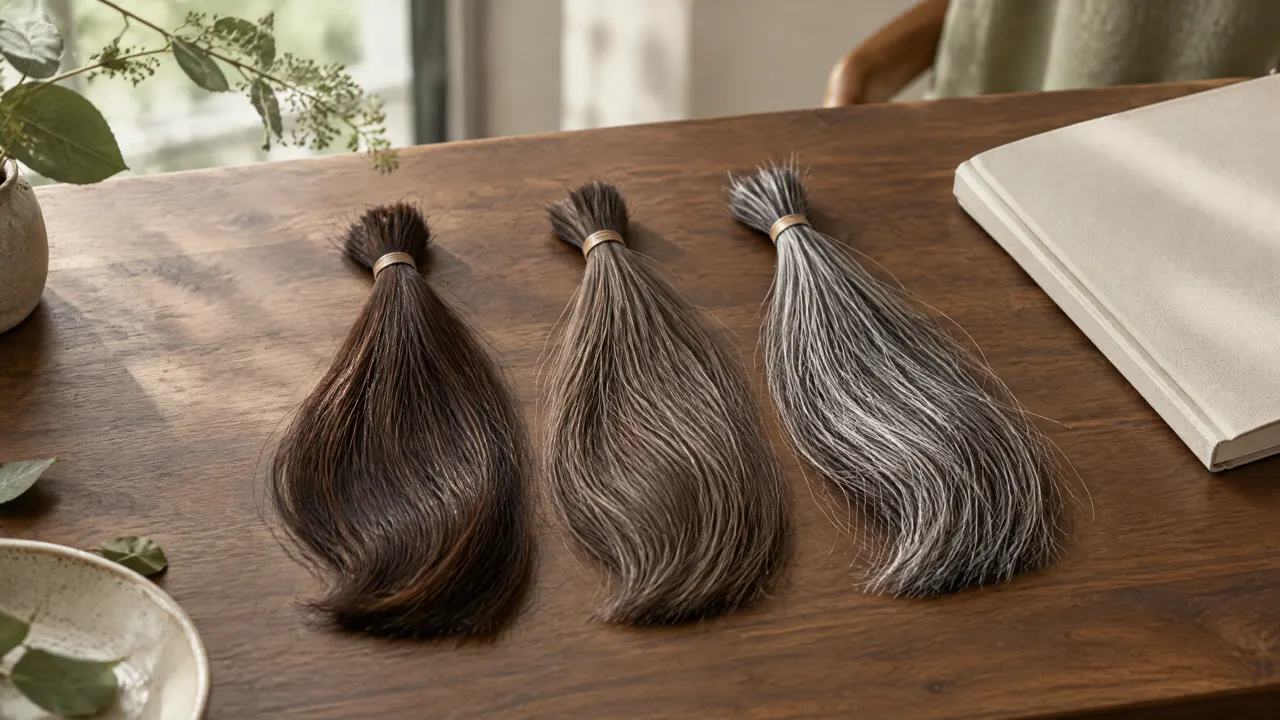
A partial piece leaves some natural hair in view, so the quotation should specify the intended relationship between the two. Record the hair length you expect to keep and the colour reference used. The American Cancer Society recommends comparing existing hair or a swatch with wig colour in natural light. [2] This is a useful comparison method, not a guarantee of a perfect match across every lighting condition.
If you want a grey blend, clarify whether the discussion concerns the topper’s overall appearance, a specific proportion or a particular distribution of lighter strands. Do not assume a grey percentage alone reproduces where your own grey appears. Canvas Blend’s grey-coverage hair-colour information belongs to planning services on natural hair; you may instead choose to preserve your current hair and seek a compatible piece without colouring it.
Reference photographs should identify priorities rather than demand an exact replica. Use Canvas Blend’s gallery for broad tone or silhouette ideas, while recognising that salon images do not establish topper construction, density or availability. Mark which feature you actually want: softer ends, less crown height or a warmer overall impression. A supplier can then explain whether that feature changes the specification or simply the finishing discussion.
If blending appears to require a natural-hair trim, treat it as a separate consent and scope question. Ask what would be removed and whether the result should also work when you are not wearing the topper. Do not authorise an unnecessary colour change to compensate for an unconfirmed shade. Keeping your own haircut intact may be a valid priority, even if it narrows the acceptable topper options.
06
What does a useful trade-off look like in a hypothetical buying decision?
Consider this explicitly hypothetical example, not a real customer or an Ownstrand offer. A buyer wants top coverage while keeping their current shoulder-length hair unchanged. Proposal A describes a base measuring 12 cm front-to-back by 9 cm side-to-side and quotes only the piece. Proposal B describes a 14 cm by 11 cm base with one fitting and specified finishing. These illustrative dimensions are not fit recommendations.
The buyer first asks why B uses a broader footprint. If the supplier can show that its proposed attachment locations work better with the buyer’s actual hair and the edges sit acceptably, the added coverage may be useful. If the only explanation is ‘bigger looks fuller’, the buyer still lacks a reason to choose it. Neither base can be judged from its dimensions without placement and attachment assessment.
Next, the buyer asks A’s supplier what a fitting and the required finishing would cost, and asks B’s supplier whether finishing includes a trim of the buyer’s own hair. Suppose A leaves service charges unconfirmed, while B requires a natural-hair change the buyer does not want. The correct decision may be to request revised scopes from both, rather than declaring either headline quote the winner.
This example shows why a written non-negotiable can be more useful than a vague request for the best topper. ‘Keep my natural haircut unchanged’ exposes a meaningful trade-off. Other buyers might prioritise a particular parting or easier daily handling. Choose only after the proposal answers that priority, the fit has an appropriate assessment route and the total agreed scope is clear enough to accept knowingly.
07
What should you verify before payment and again at the fitting?
Before authorising production, request a written summary of the agreed design and unresolved details. Confirm what action constitutes an order, when any payment is due and what happens if a requested feature cannot be supplied. A message asking for information is not a reservation, payment or completed order. Catalogue presence and a consultation discussion also do not prove current supply, immediate sample access or a confirmed completion date.
Ask for the applicable cancellation, alteration and return terms before paying. The American Cancer Society explicitly recommends checking return policies before a wig purchase, noting that retailers may restrict returns or apply fees. [2] That is general shopping guidance, not a statement of Hong Kong law or Ownstrand’s policy. A made-to-order piece needs its own confirmed terms, including what happens if it differs from the written specification.
At the fitting, revisit the agreed placement before approving finishing. Check the coverage boundary, visible parting, contact comfort and how the piece meets your own hair in the style you normally wear. Ask to distinguish a correctable styling difference from a construction issue. Avoid approving a major cut while a base or attachment concern remains unresolved; removing hair is not a substitute for answering whether the piece sits as agreed.
Keep the two businesses’ service scopes separate. A Canvas Blend booking enquiry can clarify an appointment for your own hair, but it does not order an Ownstrand topper or establish installation, adhesive work or a combined package. Ownstrand’s sole confirmed shop is Unit 2103, 50 Hoi Yuen Road, Kwun Tong, Hong Kong (利寶時中心). Confirm the requested consultation arrangement with Ownstrand rather than assuming other district pages describe branches.
- Keep one dated specification covering dimensions, placement, hair, construction and attachment.
- Mark every unconfirmed inclusion or charge before comparing totals.
- Confirm order authorisation, payment stages and applicable change or return terms.
- Recheck the agreed coverage and comfort before approving irreversible finishing.
The best-documented quote is easier to evaluate; it is not automatically the best-fitting piece.
What else should you know?
Does a custom topper quotation automatically include cutting my own hair?
No. Ask whether any cutting concerns the topper, your natural hair or both, and confirm your consent separately. A reference to fitting and styling does not settle that distinction.
Can I compare two quotes using base dimensions alone?
No. Compare measurement orientation and method, the proposed placement, attachment positions and intended coverage as well. Identical dimensions can still describe different constructions and wearing arrangements.
Should I add the same margin to every topper measurement?
No. A manufacturer’s margin instruction belongs to its stated selection method. Ask the supplier how the actual design allows for coverage and attachment rather than applying one rule to every custom base.
Are general custom-wig prices valid topper prices?
Not without confirmation for your exact requested piece. Ask for a current, dated quote specifying the topper design and inclusions. Do not treat another category’s reference amount as your order price.
What if a clip position pulls or irritates my scalp?
Do not accept persistent pulling or pain as an unavoidable part of fitting. Ask for the placement to be reassessed. Persistent pain, redness, broken skin or concerns about hair loss require healthcare advice; no alternative attachment is automatically suitable.
Does requesting a quote reserve a piece or start production?
An enquiry alone does not establish a reservation or order. Confirm supply, the final specification, payment requirements and the precise authorisation step directly with the supplier before expecting production or collection.
What is the practical next step?
Your next step is to send a short coverage description and ask for a quotation linked to a written specification. Request the proposed dimensions with their measuring method, the intended attachment positions and the exact service inclusions. Keep a natural-hair change out of the agreement unless you genuinely want it. Where a detail cannot yet be confirmed, ask what assessment or decision is needed to resolve it.
Then compare the proposals against the same priorities, not against the same hairstyle photograph. A quote becomes useful when it explains what you are buying, what still needs checking and what happens after you authorise the work. If those answers remain incomplete, pause rather than filling the gaps with assumptions about fit, availability or included services. This protects both your budget and the choices you want to keep reversible.
For hair that looks dry, frizzy, or prone to breakage in a photo, read about damaged hair treatment Hong Kong to help frame questions for a colour-care consultation.
Sources and editorial notes
This AI-assisted Canvas Blend guide is not a real-client case study or an article reviewed by Vit So. OWNSTRAND and Canvas Blend share ownership; links are not independent third-party endorsements. Confirm wig, hairpiece and natural-hair services, fees and appointments separately. Materials, stock and handling limits depend on the actual product. Appearance coverage does not replace medical assessment of hair loss or scalp concerns.
Canvas Blend Editorial — AI-assisted guide, prepared on 2026-11-06. Ownstrand and Canvas Blend have the same owner, so this is not an independent third-party recommendation. The buying example is explicitly hypothetical; no customer testing or firsthand fitting results are claimed. Ownstrand service descriptions are limited to the supplied verified brief and require confirmation for the exact requested piece. This guide does not confirm stock, universal material suitability, medical benefit, adhesive installation or a joint service package. No authorship or review by Vit So is claimed.
Continue reading
Wig SelectionWhat do wig prices in Hong Kong include when comparing custom wigs and toppers?
Compare custom full-wig and topper quotes on separate lines, with coverage, fitting, finishing, natural-hair work and order terms made explicit.
Wig SelectionWhat should you check at a custom wig fitting Hong Kong completion visit?
Prepare for a completed custom wig fitting with questions about comfort, agreed appearance, irreversible cutting, care instructions and unresolved collection details.
Wig SelectionHow do you write a repeatable colour brief for grey wigs?
Turn grey percentages and salt-and-pepper placement into a clear shopping brief: define the base, map visible zones, compare references and rank acceptable compromises.