Coverage × Comfort × Personal Choice
What do monofilament wigs and hand-tied labels tell you about each cap zone?
瀏覽獨立繁體中文指南 →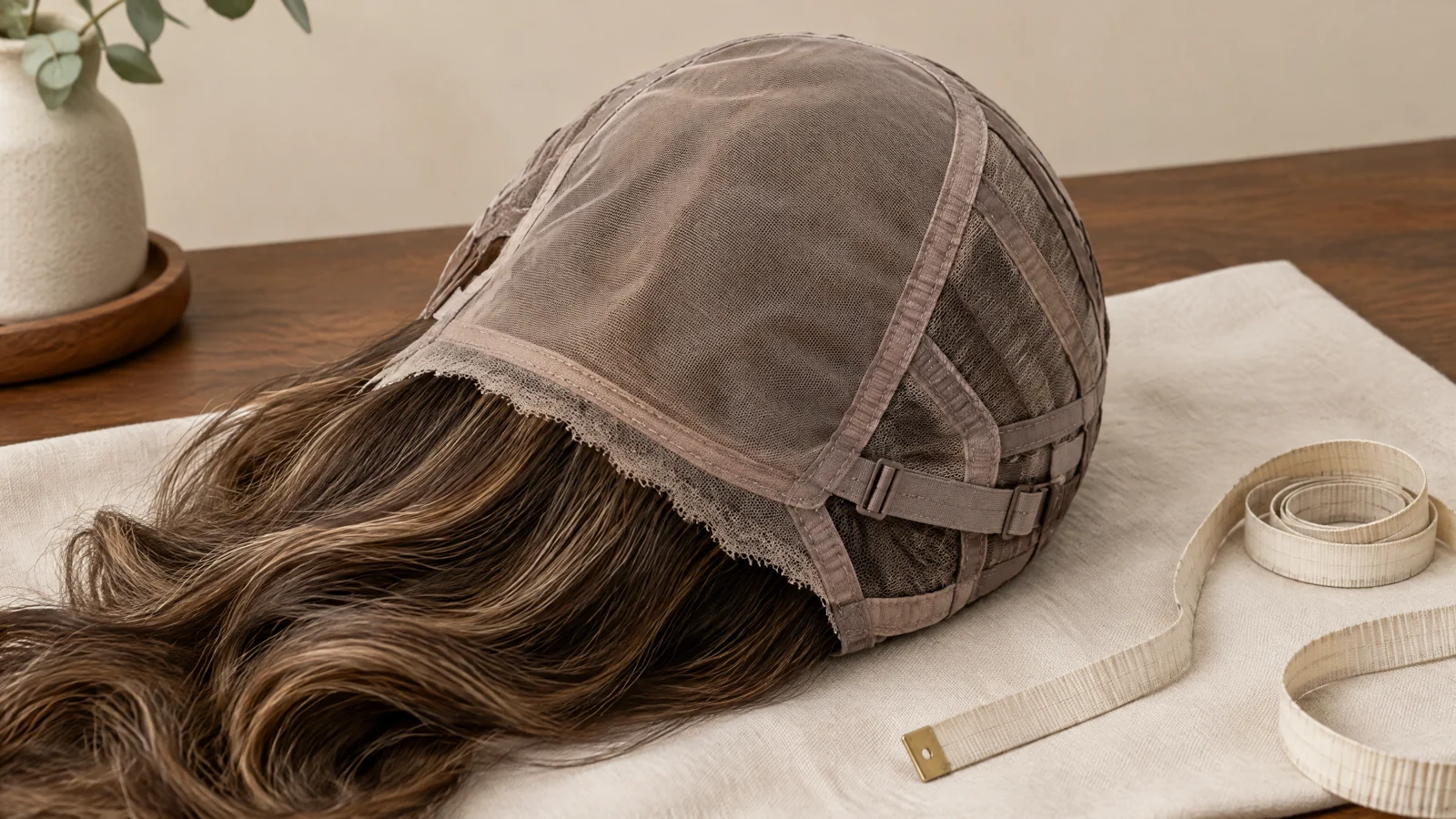
Compare the front, parting area, crown and remaining cap separately: monofilament describes a mesh construction, while hand-tied describes how hair is attached in the specified area. Neither label alone proves that the whole cap has the same construction, unrestricted parting or a comfortable fit for you.
A listing that combines several construction terms can look more informative than it really is. The missing detail is often where each feature begins and ends. Before paying for an upgrade, connect every claim to the area you will expose or feel against your head. A refined top is not automatically a refined front, and an individually knotted front does not establish how the back is built.
This is a Canvas Blend Editorial, AI-assisted buying guide, not a laboratory comparison or an account of customer trials. Canvas Blend and Ownstrand have the same owner, so these links are not independent third-party recommendations. The Canvas Blend background provides context for the editorial identity; the practical task here is to identify verifiable cap details rather than accept a seller's preferred label as a complete specification.
From root touch-ups to pre-wedding colour planning, use balayage price Hong Kong as an initial reference and discuss your current hair condition before confirming the service.
01
Which part of the cap does each construction claim describe?
Start with a simple cap map: front edge, parting area, crown, sides and back. Next to each area, record the named base material and how the hair is attached. Leave gaps blank rather than extending one claim across the whole map. This separates three questions that are easily confused: what the base is, where it sits, and whether the hair uses individual knots or sewn wefts.
The distinction is visible in a real manufacturer's specification. Jon Renau lists Carrie Hand Tied as Lace Front / Single Monofilament / Hand tied, then explains the front, monofilament area, hand-tied cap, stretch section and tabs separately. [1] That is evidence that several features can coexist, not proof that every similarly named wig uses Carrie's materials, measurements or construction. It also does not establish availability at a Hong Kong seller.
When browsing monofilament wigs, use the category as a starting point for questions, not a substitute for a particular model's diagram. Ask whether the mono area is a defined part, a crown panel or a broader top. Then ask what surrounds it. A description that names only the top still leaves the front edge, side panels and back attachment method unresolved.
A good answer should locate boundaries you can understand. For example, a seller might identify a mesh panel that ends before the ear tabs and show wefts below it. That is more useful than repeating 'premium cap'. You do not need to learn every manufacturing term; you need enough detail to determine whether the claimed feature covers the area relevant to your usual hairstyle.
Treat each label as an area-specific claim until a model-level specification establishes wider coverage.
02
Does a monofilament section let you move the part everywhere?
Monofilament generally refers to fine mesh that can create a scalp-like impression where hair emerges. The American Cancer Society describes mesh at the crown or across a cap and notes that monofilament wigs may be partially or fully hand tied. [2] Its general explanation does not establish the usable parting range of an individual item. The location of the mesh matters as much as the presence of mesh.
A defined mono part can be a sensible choice if you expect to keep the same parting position. However, ask whether the panel merely follows a fixed styled line or allows some movement within its width. A crown panel addresses a different visible area. Neither description should be read as permission to move a side part across the entire top or to expose an unconfirmed front edge.
Broader mono coverage may be relevant if you regularly alternate between a centre and side part. Jon Renau describes multidirectional parting for the single monofilament component on the cited Carrie model. [1] Keep that statement attached to that model. For another wig, verify where the top panel ends and whether hair direction, density or surrounding seams limit the arrangement you want to wear.
Make the question concrete by showing the seller two parting positions you actually use. Ask to see both on an appropriate sample, without pulling or forcing the fibres. If your preferred line crosses beyond the confirmed mesh area, record that as a mismatch or an unresolved detail. Extra top coverage only earns its place in your budget when it supports a change you are likely to make.

03
Does hand-tied mean the entire cap is individually knotted?
Hand-tying concerns the attachment method: hairs or small groups are knotted into the specified base rather than carried on sewn strips. The American Cancer Society distinguishes hand-tied construction from machine-made construction and explicitly recognises partially and fully hand-tied monofilament designs. [2] The buying implication is important: individual knots in one visible section do not establish the same attachment method in every other section of the cap.
For a hand tied wig, ask whether the wording describes the front, top or whole hair-bearing base. Request identification of any wefted areas. If the seller uses 'fully' or '100%', ask how the perimeter, stretch panels and non-hair-bearing tabs are treated. A precise explanation is preferable to guessing that every piece of fabric must look identical inside the cap.
Hand-tied and monofilament are therefore not competing answers to the same question. One identifies an attachment approach, while the other identifies a base construction in an area. A wig can combine them and still include other components. In the Carrie specification, even the hand-tied cap is described alongside velvet ear tabs, a nape area and adjustable tabs. [1] Those separate components deserve attention during a fit check.
Do not turn craftsmanship into a universal comfort or durability ranking. A seam, an edge or the position of an adjustment tab may matter more to your experience than the amount of hand-knotting. Compare how the exact cap sits with your own hair arranged as intended. Nor does hand-tying tell you the fibre: human hair and synthetic fibres require their own confirmed descriptions and care directions.
Before choosing a new tone, the guide to hair colour salon Sheung Wan can help you consider access from Central, natural daylight, and an appointment time that suits your week.
04
How should silk-top wording fit into the same comparison?
A silk top wig introduces another top-construction claim, not a complete description of the cap or a guaranteed fabric composition. Ask how the maker defines the term for that item, which layers or materials are confirmed, and how far the named top extends. Do not translate silk-top, French-top, lace-top and monofilament into interchangeable promises merely because each description mentions a scalp-like part.
A fair comparison uses the same questions for each option. Where is the intended part? What is visible along it? What lies between the knots and the wearer? How does the top join the surrounding cap? If an answer is missing for one option, mark it unconfirmed rather than giving that option a better score based on a more luxurious-sounding name. The table below is a question framework, not a quality league table.
Appearance should also be judged at the angle from which the part will normally be seen. A close-up taken from directly above can answer a construction question without showing how the top looks when someone stands beside you. Ask for consistent lighting and comparable views. The Canvas Blend gallery can help describe a hairstyle or tonal direction, but salon photographs cannot verify a wig's hidden layers or cap workmanship.
Keep the front separate throughout this exercise. A top that gives the parting finish you prefer may still have a front edge unsuitable for the way you sweep hair away from your face. Conversely, a front-focused feature may add little to your fixed, covered hairline. Choosing between top descriptions becomes easier when you stop expecting one label to settle every visible area and every contact point.
| Claim on the listing | Question it helps answer | Detail still needed |
|---|---|---|
| Mono part | How is the stated parting area built? | Panel boundaries and whether the intended part can move within them |
| Mono crown | How is the crown area presented? | Whether it reaches the part or front you plan to expose |
| Mono top | What mesh construction is named across the top? | Exact coverage, surrounding seams and model-specific parting guidance |
| Hand-tied section | How is hair attached in that section? | Which other areas are knotted or wefted |
| Fully hand-tied | What extent of hand-knotting is being claimed? | The maker's definition and separate perimeter or tab components |
| Silk top | What named top construction is being offered? | The maker's explanation of layers, materials and top boundaries |
| Lace front | What construction is named at the front edge? | Top and back construction, plus the actual front coverage |
05
What can you verify on a sample without changing it?
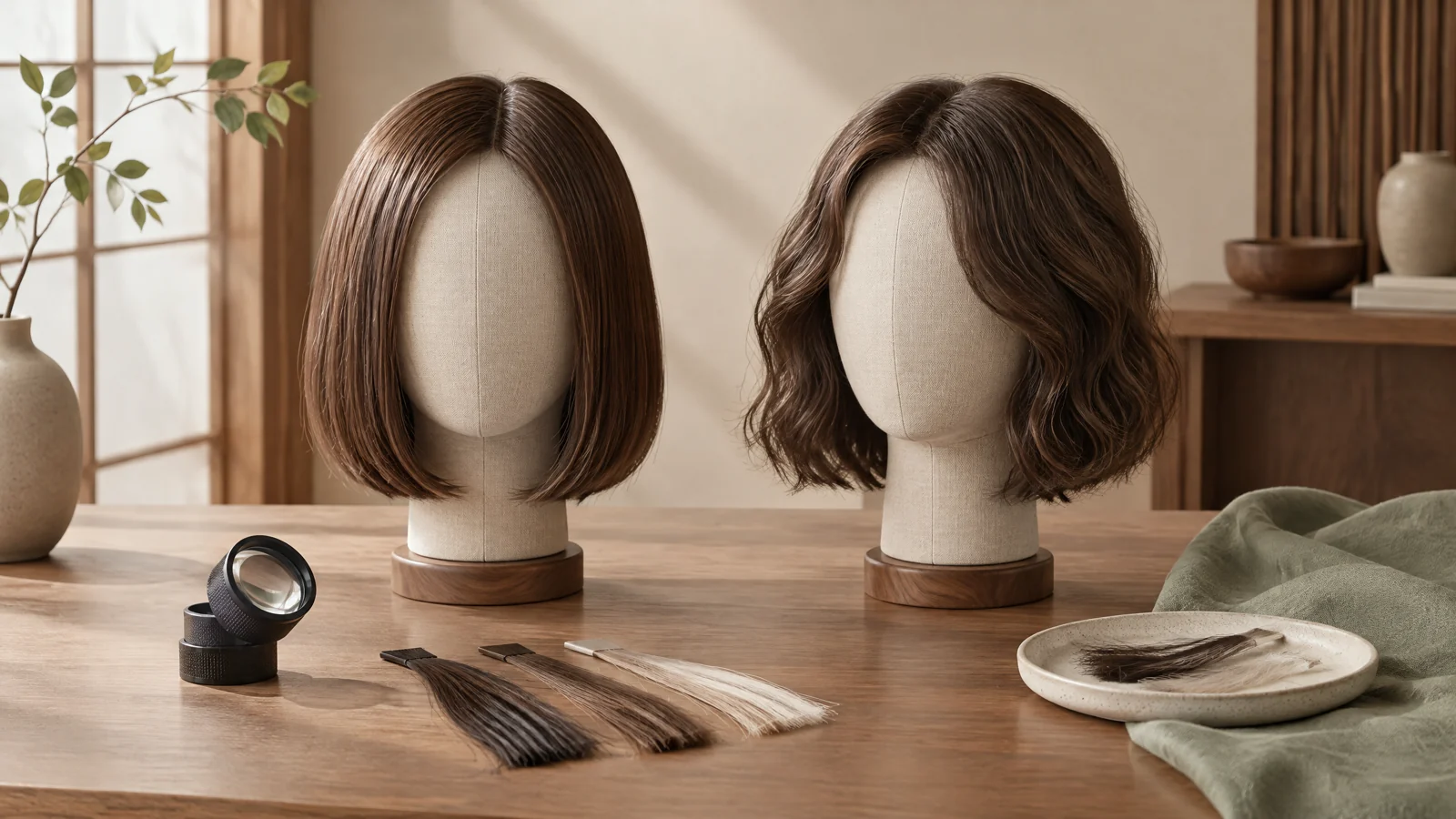
Ask permission to view the inside of the cap and compare it with the written specification. Look for the edges of panels and the location of sewn strips, then have the seller identify anything unclear. Do not use an unlabelled interior photograph as your only evidence: a picture can show a boundary without reliably establishing fabric composition, the full attachment method or the exact version being offered.
During an agreed fitting, check front placement, tab position and the nape with the natural hair arrangement or liner you intend to use. The American Cancer Society advises checking the brand's own sizing chart because size descriptions can vary. [2] A cap that looks convincing on a mannequin may fit differently on your head. Repeated pressure, movement or an uncomfortable seam is relevant evidence, not something a prestigious label cancels out.
If your scalp is sensitive, inspect the contact areas rather than assuming mono or hand-tied means universally suitable. The sensitive-scalp colour guide concerns separate salon colour precautions; it does not establish wig suitability or treat hair loss. Stop wearing a piece that causes discomfort, and seek healthcare advice for persistent pain, redness, broken skin or concerns about the cause of shedding. A wig is an appearance choice, not a medical treatment.
Document the version and condition you examined before any alteration. Note the style identifier, fibre, stated cap design and your observations under ordinary lighting. If some natural hair remains visible, keep its trim and colour history distinct from wig care; the before-and-after record guide can help organise that separate reference. Do not cut lace, bleach a base or chemically change the sample to test a claim.
06
When would extra top or hand-tied coverage earn its cost?
Consider this explicitly hypothetical buying example, not a real customer or a pair of advertised products. Assume Option A has a defined left mono part, a covered front and wefted sides and back. Assume Option B has a broader mono top, a specified lace front and hand-tied sides and back. Also assume A has the lower quotation, both pass the same fit check, and their fibre and colour are comparable.
Buyer One always wears a left part with a fringe covering the front edge. Under those assumptions, A may deliver the feature the buyer actually exposes without paying for unused parting range. B's additional front and top features could still matter if the hairstyle changes, but that is an optional benefit rather than an immediate requirement. The lower quotation is attractive only after the stated left part and comfortable fit are verified.
Buyer Two alternates between centre and side parts and regularly sweeps the front away from the face. B is the stronger candidate on paper because its confirmed zones align with both habits. Yet the buyer should still see those arrangements and assess the contact areas. If B creates uncomfortable pressure or its usable top falls short of the intended part, more extensive construction does not rescue the mismatch.
Now change one assumption: neither buyer can obtain a clear interior diagram or a written scope statement for B. Its extra cost is then attached to unresolved claims, not confirmed benefits. Ask for the missing information before choosing; do not fill the gap with expectations about handwork. This example deliberately uses no price figure, stock claim or lifespan estimate. It demonstrates how evidence and actual styling habits can outweigh the number of labels.
07
What should be confirmed before an enquiry becomes a purchase?
Send a short, model-specific enquiry rather than asking which construction is best. Identify the item and the parting positions you want, then request a cap map or equivalent written explanation. Ask which zones are mono, which are hand-tied, what any silk-top wording means and where other materials or wefts appear. A quotation should identify the offered configuration rather than leave you comparing an unspecified category with a named model.
Keep commercial confirmation separate from technical confirmation. A published category or photograph does not prove that a size, colour or material is in stock. Ask about the exact item, fitting arrangements, what any quoted service includes and the applicable return or alteration conditions before payment. A message requesting information is not automatically an order. Do not assume that the sample you saw and the version being quoted have identical cap details.
Care instructions are another independent checkpoint. Jon Renau's buying guide treats fibre and cap construction as separate factors, and the American Cancer Society cautions against using heat tools unless a wig is heat resistant. [3] [2] A mono top or hand-tied base does not establish heat tolerance, permission to colour the hair or suitable products. Obtain the instructions for the exact item rather than adopting a fixed temperature or another model's routine.
If retained natural hair needs salon attention, use Canvas Blend booking to ask about that service scope separately. An Ownstrand style link is not evidence that Canvas Blend supplies wigs, provides adhesive installation or offers a joint package. Confirm any wig enquiry with the relevant seller, and any natural-hair appointment with the salon. This keeps your construction decision from becoming entangled with an unconfirmed service assumption.
- Match the style identifier and version to the specification and quotation.
- Record each cap zone, including any detail that remains unconfirmed.
- Verify your intended parting and front exposure without altering the sample.
- Check fit, care directions and purchase conditions for the exact item.
What else should you know?
Can a wig be both monofilament and hand-tied?
Yes. Monofilament identifies a mesh construction, while hand-tied identifies how hair is attached in the stated area. The combination does not establish that every cap zone has the same construction; check the individual specification.
Does a mono crown mean I can create any side part?
No. A crown panel may not extend into the side-parting area. Ask where the panel ends and whether the intended part is supported on that model rather than inferring a range from the word mono.
Is a hand-tied top proof of a fully hand-tied cap?
No. The sides or back may use a different attachment method. Ask which areas are individually knotted and whether there are sewn wefts elsewhere. If fully hand-tied is claimed, request the maker's definition of that coverage.
Does silk-top wording prove that all the cap fabric is silk?
No. It is a top-construction label, not a complete material declaration. Confirm the specific item's layers, materials and boundaries, and do not assume that French-top or monofilament wording means the same thing.
Is the most elaborate cap always the most comfortable?
No. Fit, seams, contact materials and how you arrange your natural hair can affect comfort. Inspect and, where arranged, try the exact design. Persistent pain, redness or skin damage calls for healthcare advice rather than another construction label.
Can I use heat because the cap is hand-tied or monofilament?
Those labels do not establish heat tolerance. Confirm the fibre and use the exact manufacturer's care instructions. Do not infer a safe temperature or permission for chemical alteration from cap construction.
What is the practical next step?
Before narrowing the shortlist, write down the one parting position or styling change your next wig must support. Compare the candidate caps against that requirement, then inspect the remaining zones for fit and unresolved details. A limited panel with a clear specification can be a more rational choice than a broader claim you cannot verify. Equally, extra coverage can be worthwhile when it enables something you genuinely intend to wear.
Your next useful step is to obtain a model-level answer, not collect another construction adjective. Keep the cap map, sample observations and purchase conditions together, and resolve any disagreement before altering or buying the item. If a claim remains unclear, treat the related benefit as unconfirmed. The aim is a defensible personal choice based on construction, fit and service boundaries, without promises about universal comfort, medical effects or availability.
When looking up hair salon Central, check the location details and choose a consultation time that lets you compare tones in natural daylight before or after work.
Sources and editorial notes
- [1] Jon Renau — Carrie Hand Tied: specifications and cap design
- [2] American Cancer Society — Wigs for Hair Loss
- [3] Jon Renau — The Beginner's Guide to Wig Buying
This AI-assisted Canvas Blend guide is not a real-client case study or an article reviewed by Vit So. OWNSTRAND and Canvas Blend share ownership; links are not independent third-party endorsements. Confirm wig, hairpiece and natural-hair services, fees and appointments separately. Materials, stock and handling limits depend on the actual product. Appearance coverage does not replace medical assessment of hair loss or scalp concerns.
Canvas Blend Editorial — AI-assisted guide, prepared 2026-11-06. Ownstrand and Canvas Blend have the same owner; this is not an independent third-party recommendation. No claim is made that Vit So wrote or reviewed this article. No customer trials, wear tests or laboratory material verification were conducted; the buying example is explicitly hypothetical. Manufacturer descriptions apply only to the identified model, and all item specifications, fitting arrangements, availability and service scope require direct confirmation. This guide concerns appearance and purchasing, not diagnosis, treatment or hair regrowth.
Continue reading
Wig SelectionHow should you choose a men's hairpiece for work and compare crown-coverage quotes?
Compare crown hairpiece footprints, workday fitting checks and itemised quote conditions before committing, with a hypothetical office-wear decision example.
Wig SelectionHow can a custom men's hair system enquiry preserve your options?
Plan a custom hair-system enquiry around reversible choices, written permissions and cosmetic limits. Compare wearing commitments before changing your own hair or approving production.
Wig SelectionWhich men's hair system for receding hairline keeps the front shape you want to show?
Choose front-hairline coverage without erasing a familiar outline: compare visible temples, existing hair, density transitions and realistic fitting checks.