Shape × Colour × Personal Choice
How to set realistic brunette goals with no bleach hair colour
瀏覽獨立繁體中文指南 →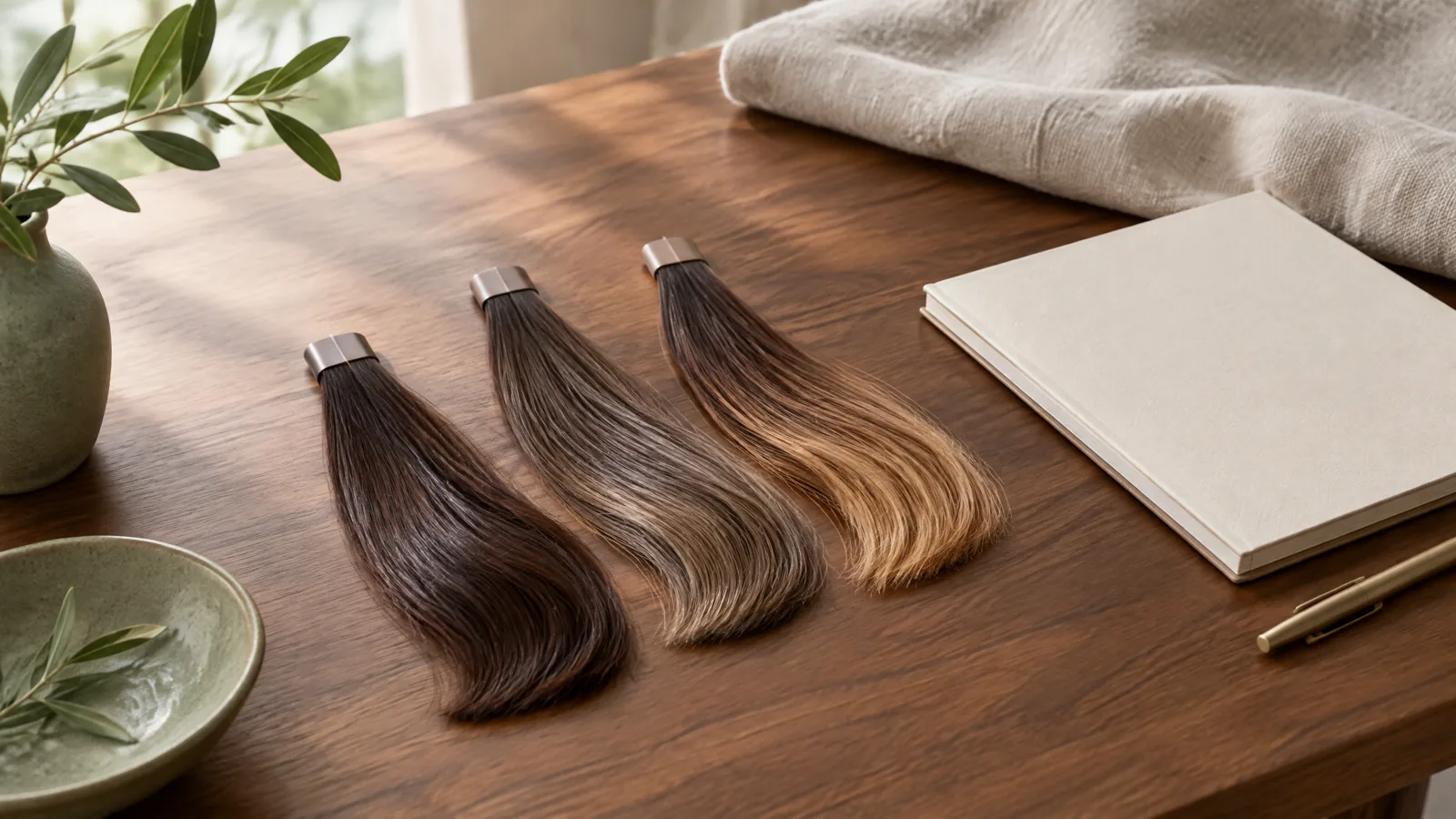
A realistic no-bleach brunette goal starts with your current hair and usually makes more sense as a depth-and-tone preference than a promise to match a photograph. Separate natural roots from dyed lengths, state whether avoiding bleach is a firm boundary, and assess a darker alternative if the desired brightness cannot fit that boundary.
Brown is a broad colour family, not a description of how much processing a change will require. A deep brunette reflection on natural dark hair is a different request from a pale, cool brown on lengths carrying repeated dark dye. The useful starting question is not which brown is fashionable, but what you want to change about the hair you actually have.
This guide helps you translate inspiration into an assessable request. The external overview of hair colour discusses depth, reflection and coverage rather than treating a shade name as a complete booking. For Canvas Blend's related starting-point guidance, read no-bleach colour options. Keep the preferred result separate from the decision about which process, if any, suits your hair.
If you prefer a softer change, discuss ombre hair colour Hong Kong alongside hand-painted highlights or a lower-contrast gradient, so the placement reflects your existing colour and everyday styling.
01
What does a no-bleach brunette goal actually mean?
First decide what you mean by avoiding bleach. You may want to avoid a separate bleaching step, avoid any lightening of your natural depth, or avoid further chemical work on fragile lengths. Those are different boundaries. Saying only 'no bleach' leaves room for a misunderstanding about both the visible change and the kind of colouring you would accept.
Wella's professional guide describes lightening naturally uncoloured hair with particular colour-and-developer systems without a separate bleach product. This supports a limited but important point: no bleach does not necessarily mean no lightening or no developer. It does not establish a formula for your hair, and it is not evidence that any particular salon uses those products. [1]
If retaining your current darkness is important, say that explicitly. A useful request is 'keep the overall depth close to my roots, but discuss a softer brown reflection'. If you instead want the hair clearly lighter in an ordinary room, make that expectation equally clear. A warm sheen visible only beside a window may not satisfy someone expecting a visibly lighter silhouette.
The external no bleach hair colour page frames the service as an enquiry based on the existing base, previous dye and intended change. Use it to understand that consultation intent, not as a list of guaranteed shades. A sensible alternative may be keeping the deeper base, changing the reflection, or deciding against colour until the uncertainties are assessed.
Define whether your boundary is no bleaching step, no lightening, or no additional processing on selected areas before choosing a reference.
02
Why do natural roots and previously dyed lengths need separate decisions?
A head of hair that looks uniformly dark may contain several different starting points. New roots can be untouched, mid-lengths can hold permanent dark tint, and the ends can include older highlights covered by later dye. An overall photograph does not reveal that history. The same final appearance should not lead you to assume identical handling from roots to ends.
Wella separates its virgin-hair lightening techniques from previously coloured hair and states that tint is insufficient for reducing existing oxidative colour depth in the situation described. [1] The practical implication is to assess old artificial pigment separately. A lighter brown result shown on natural hair is not proof that putting a similar tint over darkened lengths will produce the same brightness.
Make a simple area-by-area history rather than reporting only your most recent appointment. Include home dye, salon colour, toners and colour-depositing products. Mention previous bleach, straightening, perms and henna or products described as plant-based. Where possible, bring packaging photographs. If the product or date is unknown, record that uncertainty rather than guessing a brand or pretending the hair is untouched.
Also show differences you normally hide with styling. An old dark band near the middle, pale ends underneath, or a warmer hairline may change what an even brunette result requires. Photograph the parting and the lower lengths with the hair dry. Explain whether consistency matters more than becoming lighter, because keeping some existing depth can be a more relevant goal than removing it.
Ask whether an in-person assessment or a strand assessment is appropriate before agreeing to a major change. A strand assessment examines a small section's response; it is not an allergy test or a whole-head result guarantee. If the lengths are already breaking, start with the concern discussed in damaged hair care rather than assuming another tint is harmless because bleach is absent.
Treat each area's colour history as decision information, especially when the desired brown is lighter than old dark dye.
03
How can you separate brunette depth from warmth in a reference photo?
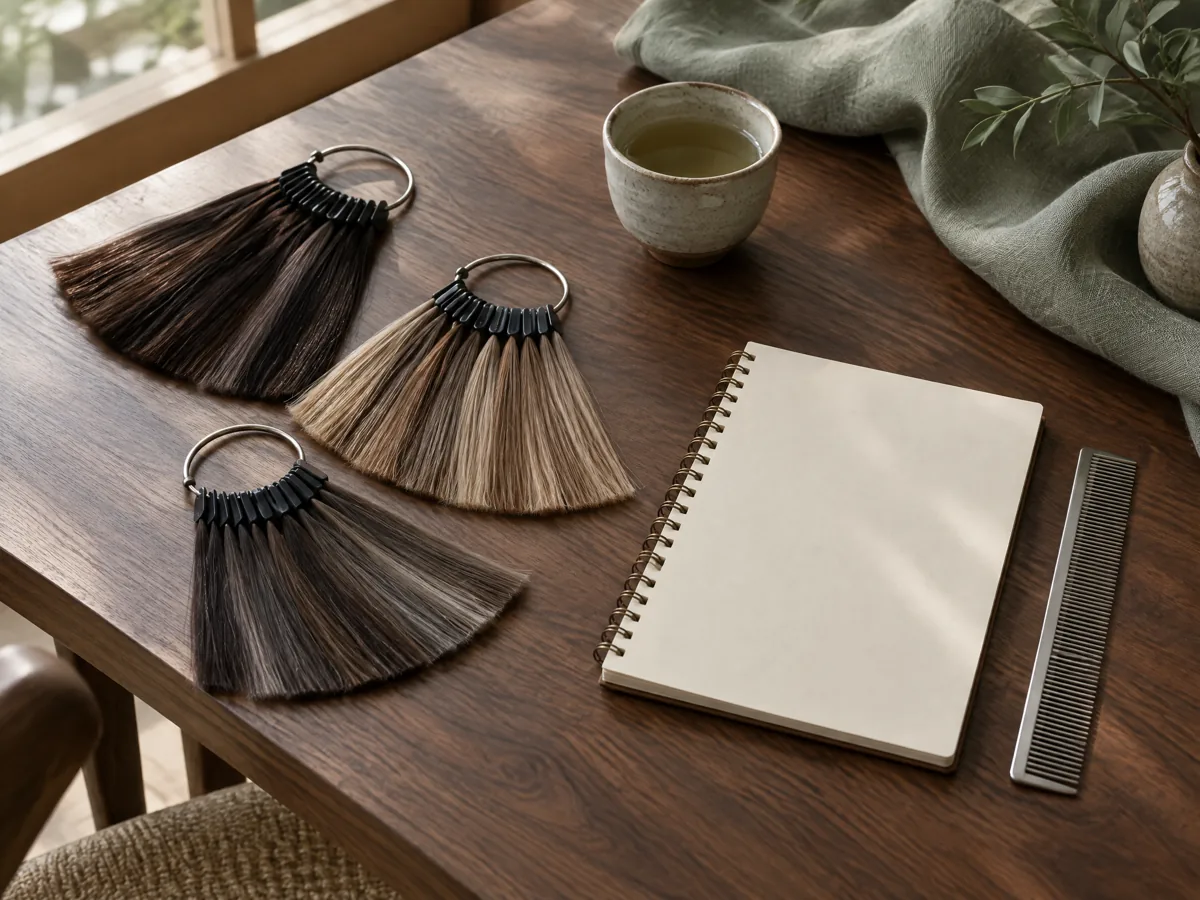
Depth is how light or dark the overall hair appears; tone is its colour direction, such as a golden, reddish or cooler reflection. Look at the shaded hair behind an ear or underneath a wave before looking at the bright surface. If those shaded areas remain very dark, the reference may appeal because of reflection rather than a consistently lighter base.
Compare the crown, middle and ends separately. A dark crown with brighter lengths is not the same design as medium brown throughout. A front-facing photograph may also exaggerate the effect of a small lighter area near the face. Save the entire picture and describe which area matters, rather than cropping away the darker hair that explains how the result looks balanced.
The external guide to brown hair colour compares darker, medium and lighter brunette appearances before choosing reflection. Use those as visual descriptions, not universal formula numbers. If a picture is labelled chocolate or ash, still explain whether you like its shaded depth, its warm glow, or its lack of an obvious reddish reflection. Names alone leave too much unresolved.
Take your own photographs in soft daylight and in the indoor light where you usually see yourself. Keep the hair dry, include the roots, and avoid beauty filters. Canvas Blend's colour photograph guide can help you organise those views. The purpose is a fairer discussion, not a calibrated measurement; cameras, screens and room lighting can still make apparently similar browns look different.
Warmth and brightness can pull a request in different directions. You may prefer a lighter outline but dislike any golden reflection, or want a cooler appearance without accepting a darker overall finish. Ask which part of that combination is realistic on your base. If a darker interpretation is proposed, compare it in ordinary light rather than accepting it because the shade name sounds right.
Before a first colour appointment or a refresh, browse hair bleaching Hong Kong for visual inspiration, practical preparation and a clearer sense of what to discuss during your consultation.
Choose the shaded depth you want first, then describe the reflection and the areas where you want it visible.
04
Which brunette direction best fits your starting base and priorities?
Start by ranking the result, not the product. If avoiding bleach is non-negotiable, the acceptable shade has to fit that boundary after assessment. If brightness matters more, acknowledge that the original boundary may prevent the preferred result. Keeping both as absolute promises gives a stylist no honest way to explain a limitation. You can decline the proposed change rather than treating compromise as compulsory.
A nearer-depth brunette is a useful option when your main dissatisfaction is reflection rather than darkness. It should still be assessed against existing dye and the condition of the lengths. The American Academy of Dermatology notes that chemical appearance treatments can cause dryness and brittleness, and that larger lightening changes generally involve more damaging peroxide exposure. That is a reason to compare modest changes, not a guarantee that dark colour is damage-free. [3]
Medium brown may suit someone wanting the hair to read clearly as brown indoors, but the label does not settle whether their existing lengths can reach it without removal of old colour. Light brown demands an even clearer comparison with the current base. Choosing brown rather than blonde does not automatically make a process simple, and choosing cool rather than warm does not establish how much lightening is needed.
Placement is another separate choice. If you want distinct brighter pieces rather than an overall tint, use the highlights comparison to frame the design discussion, but do not assume that choosing fewer strands makes them bleach-free. Conversely, if your lengths already suit you and only regrowth is the issue, root touch-up planning may be more relevant than another full-head application.
| Your priority | Direction to discuss | Main limitation to assess | Question that helps decide |
|---|---|---|---|
| Keep a deep outline | Near-base brown with a changed reflection | Old dye, uneven ends and acceptable warmth | Can the reflection change without making the overall hair lighter? |
| Look visibly browner indoors | An overall medium-brown reference | Difference from natural roots and dyed lengths | Which areas can reasonably approach this depth within my boundary? |
| Match a pale cool reference | Separate brightness from coolness | The amount of change and existing artificial pigment | Would a deeper version be acceptable if this reference needs a different process? |
| Keep coloured lengths as they are | Targeted regrowth discussion | Root-to-length contrast and any visible grey | Can the work stay focused on the area that actually concerns me? |
| Avoid additional processing | Retain the current colour and review styling or care | Colour alone may not solve roughness or breakage | Is postponing colour a better choice for the hair I want to keep? |
There is no universal best no-bleach brown; the useful choice fits the base, the desired visibility and the priority you will not trade away.
05
Does avoiding bleach remove irritation, allergy or damage concerns?
No. Hair condition and skin tolerance are separate questions, and neither is answered by excluding bleach. The FDA explains that some hair dyes can cause allergic reactions and that sensitivity can develop after previous uneventful uses. Formulations can also change. A familiar shade or a previous comfortable appointment therefore does not establish that the next application will be suitable. [2]
Follow the product's safety instructions and ask the service provider how the required skin test is arranged before each use. The FDA recommends testing before every use and explicitly warns that a reaction can still occur despite a test showing no reaction. [2] Do not interpret a clear test as a guarantee, and do not substitute a hair strand assessment for a test addressing skin sensitivity.
If you previously experienced itching, swelling, burning or a rash after dye, tell the stylist before choosing another colour. Keep the product details if you have them and discuss the reaction with a healthcare professional. FDA guidance says not to dye an irritated, sunburned or damaged scalp. [2] A no-bleach preference is not a medical assessment or a reason to proceed over active symptoms.
Canvas Blend's sensitive scalp colour guide provides related questions to organise, not a diagnosis or treatment. If your concern is breakage rather than skin symptoms, describe where it occurs and what other chemical work is planned. Keeping colour, straightening and heat-styling history visible helps the conversation focus on the hair you intend to retain instead of only the photograph you want.
Assess allergy history, current scalp symptoms and hair fragility separately from the decision to omit bleach.
06
How should you maintain brunette colour without assuming it is effortless?
Maintenance depends on the contrast with your growing roots, visible grey, the condition of the lengths and the finish you prefer. A dark brunette can look conspicuous against naturally lighter regrowth; a close-to-base brown can still need attention if the reflection changes in a way you dislike. Ask what to watch for rather than accepting a fixed refresh interval or a claim that no-bleach colour needs no upkeep.
Build care around gentle handling before buying a collection of products. AAD guidance recommends conditioner after shampooing, gently concentrating shampoo on the scalp, and avoiding rubbing the hair with a towel. [4] These habits address everyday damage sources. They do not permanently restore chemically altered hair or guarantee that a brown shade will remain unchanged, but they give your routine a clearer purpose than a vague repair promise.
Heat use matters alongside colour. AAD advises letting hair air dry when possible, choosing the lowest heat setting and limiting contact with hot styling tools. [4] If you use a smooth blow-dry to assess your new brown, also look at it in your usual texture. You should not have to repeatedly expose fragile ends to high heat just to decide whether you like the depth.
AAD also warns that sunlight can leave chemically treated hair weak, rough, faded and brittle, and suggests a wide-brimmed hat outdoors. [3] For related routine questions, use post-colour hair care. If you are considering a tinted conditioner, disclose that product before another appointment: an extra deposit of colour belongs in the history, and its suitability should not be assumed from the word brunette.
Agree on the reason for any future refresh rather than automatically colouring the whole length again. Regrowth, an unwanted reflection and uneven old dye are different concerns. Photograph the change in comparable lighting and ask which areas actually need attention. If roughness or breakage worsens, reconsider the processing plan; if scalp symptoms occur, seek healthcare advice rather than trying to correct them with another colour service.
A realistic maintenance plan identifies what may change, how to handle the hair gently and which area needs reassessment.
07
What should you send before booking, and how can you choose an honest fallback?
Prepare a short enquiry with current photographs, a colour history by area, and one sentence naming your firm boundary. Then explain the desired depth in ordinary indoor light and the reflection you prefer. Include one reference you like and, if helpful, one you dislike with a specific reason. A photograph plus 'natural brown' is less informative than a clear statement about how visible the change should be.
Planning example, not a client case: imagine someone with naturally dark regrowth, lengths containing old dark home dye, and a pale mushroom-brown reference. They want to retain their length and will not accept a bleaching step. The immediate question is whether they would like a deeper, less dramatic interpretation. The example does not predict what a formula, strand assessment or appointment would achieve.
For that hypothetical person, a useful preference statement is 'avoiding bleach and retaining my length come first; I would consider a brown closer to my current depth, but I do not want a strong red reflection'. The coloured lengths still need separate assessment. If the only satisfying result requires a process outside the boundary, keeping the current colour is a valid outcome rather than an unsuccessful consultation.
Another person might have untouched dark hair and mainly want a brown glow in daylight. Their reference may be closer to their actual goal, but that alone does not confirm suitability or an exact match. They should still explain whether their darkness must stay unchanged and check the proposed process. The two hypothetical starting points illustrate why a reassuring shade name cannot replace a history or assessment.
Before committing, ask what is proposed for roots, mid-lengths and ends, whether any additional work changes the scope, and what the total quotation includes. Use Canvas Blend pricing information as that site's starting point and Canvas Blend booking for its enquiry route. Do not transfer another site's price or package inclusions into a Canvas Blend booking, and wait for the assessed service and appointment arrangements to be confirmed.
- State whether your firm boundary is no bleaching step, no natural-depth lightening, or no further processing on particular lengths.
- Send dry-hair views of the roots, sides and back in daylight and ordinary indoor light without filters.
- List previous colour and chemical treatments by area, keeping unknown products clearly marked as unknown.
- Rank brightness, acceptable warmth, retaining length and the amount of change instead of asking for all of them as guarantees.
- Ask about product safety instructions, any appropriate assessment, the application areas and the complete quoted scope.
An honest fallback is one you would still choose after the limitations are explained, including the option not to colour now.
What else should you know?
Can naturally black hair become brown without bleach?
Some professional colour systems can change the depth of naturally uncoloured hair without a separate bleaching step. [1] That does not establish what is suitable for your hair or how light, cool or even the result can be. Describe the intended change and ask for assessment rather than choosing a formula yourself.
Will a lighter brown dye make previously dyed dark lengths lighter?
Do not assume so. Wella distinguishes natural-hair lightening from reducing existing oxidative colour depth and says tint is insufficient for the coloured-hair situation it describes. [1] Share the old dye history and discuss the lengths separately, particularly if avoiding bleach remains a firm boundary.
Is ash brown always possible without bleaching?
No universal shade promise follows from the name ash brown. The required brightness, existing warmth, natural depth and previous dye all matter. Ask whether a deeper interpretation would meet your preference and what limitations remain before agreeing to the proposed work.
Does a skin test guarantee I will not react to no-bleach dye?
No. FDA guidance recommends testing before every use according to instructions and notes that a reaction can still happen after a test shows no reaction. [2] Report previous reactions and current scalp symptoms before the appointment, and seek healthcare advice for a suspected reaction.
Is no-bleach brunette colour the same as zero-damage colour?
No. Avoiding bleach describes a process boundary, not a guarantee about hair condition. AAD notes that colouring treatments can leave hair dry or brittle. [3] Assess fragile lengths, other chemical treatments and everyday handling rather than relying only on the no-bleach label.
How often will I need a brunette refresh?
A fixed interval cannot be established from the shade name. Discuss root contrast, grey coverage preferences, reflection changes and hair condition. Ask whether the next concern would need targeted regrowth work, a tone discussion or no additional colour rather than assuming repeated full-head application.
What is the practical next step?
Choose your next step by comparing the desired brown with your actual roots and lengths, not with a caption. Write down the depth you want in ordinary light, the warmth you would accept and the boundary you will keep. Then organise photographs and treatment history so an assessment can distinguish a modest reflection change from a much larger colour change.
A good decision can be a nearer-base brunette, a targeted plan for one area, or no colour for now. What matters is that you understand the proposed scope, safety instructions and limitations before agreeing. Keep any alternative concrete: would you still enjoy a deeper version indoors, and does it preserve the priority that made you ask for no bleach in the first place?
If you are searching for hair colour salon Central, plan a colour visit around meetings or after work, with enough time to discuss tone, upkeep, and your journey from Central.
Sources and editorial notes
- [1] Wella Professionals: How to Lighten Hair Without Bleach
- [2] U.S. Food and Drug Administration: Hair Dyes
- [3] American Academy of Dermatology: Coloring and perming tips for healthier-looking hair
- [4] American Academy of Dermatology: How to stop damaging your hair
This AI-assisted Canvas Blend guide is not a first-person case study or an article reviewed by Vit So. Vit So Hair Stylist and Canvas Blend share ownership. Links are not independent third-party endorsements and do not mean that fees, booking policies or packages are interchangeable. Colour, chemical processes, extensions and styling require individual assessment; cosmetic hair and scalp care do not replace medical advice.
AI-assisted Canvas Blend editorial guide prepared for current publication on 2026-11-06. No-bleach describes a consultation boundary, not a personalised formula, zero-damage claim or allergy assurance. The planning examples are hypothetical, not client cases. Canvas Blend and the external VitSo website share an owner; the links are not independent endorsements, and this article does not claim to be written or reviewed by Vit So. Service scope, safety arrangements and quotations must be confirmed with the relevant provider.
Continue reading
Hair DecisionsChoosing chocolate brown hair or ash brown: preparation before colour
Compare warm and ash brown by depth, reflection and placement, then prepare your hair history, safety checks and care questions before choosing a colour process.
Hair DecisionsShould you choose grey coverage or a softer regrowth plan?
Compare covering grey with keeping silver visible, separate root colour from faded lengths, and build a realistic maintenance plan with safety checks.
Hair DecisionsHow to choose root touch up vs full head colour
Compare root-only colour, a length refresh and an all-over change by coverage, grey goals, hair history and quote inclusions before booking in Hong Kong.