Water Activities × Hair Care × Travel Planning
How to choose a scuba diving course Hong Kong around your routine
Browse original Traditional Chinese water activity and hair-care guides →
Choose the learning outcome first, then check whether you can accommodate study, supervised water sessions, travel and aftercare without rushing. Compare the actual agency pathway and confirmed timetable rather than a headline duration. If you colour your hair, plan chemical treatment around the expected pool and outdoor exposure, not a universal waiting period. Before paying, confirm inclusions and written terms: all paid DiveHarbour course and activity fees are non-refundable, and make-up sessions are available only under those terms.
A free weekend is not necessarily enough space for a new water activity. You may also need uninterrupted study time, an early journey, changing facilities and a realistic return home before work or family commitments. Choosing well means looking at the whole week rather than the hours advertised for the water session. The useful question is not simply whether a course fits your diary, but whether its learning demands fit the time and attention you can actually give it.
For readers who maintain a particular hair colour, the same calendar may include a salon appointment and a holiday or event. These commitments deserve coordination, but appearance should not drive training decisions. Canvas Blend is a hair-colour salon and shares ownership with DiveHarbour; this is not an independent school review. The aim here is to help you separate the decisions, ask useful questions and avoid booking a tightly packed sequence that leaves no room for changed plans.
If your hair feels dry, fragile, or difficult to detangle after lightening, explore damaged hair treatment Hong Kong before planning another colour service or adjusting your home-care routine.
01
What do you want your first course to achieve?
Begin with an outcome you can describe without a course name. Perhaps you want to find out whether a supervised introduction appeals to you. Perhaps you want entry-level certification for future recreational diving. Or perhaps you already hold a qualification and need advice after time away. These are different enquiries, even if they all start with curiosity about Hong Kong waters. The scuba diving course Hong Kong guide is an orientation point; ask which route matches your experience rather than treating every listed activity as a beginner option.
An introductory experience should not be assumed to award an entry-level qualification. Ask what it teaches, how it is supervised and what completion means. For certification, compare the specified knowledge and water requirements. PADI describes its Open Water pathway as knowledge development, confined-water training and open-water training, with progress based on demonstrated understanding and skills.[1] That structure is useful for comparison, but a provider must still identify the agency and exact programme being offered. Do not infer that an agency route is available from a general description alone.
Think beyond the first booking. If you hope to keep diving, consider whether regular learning and water days can coexist with your working pattern and maintenance habits. Canvas Blend's guide to how often to colour hair can help frame the separate hair-maintenance conversation. Tell your stylist that water exposure may become recurring rather than a one-off holiday. You do not need to purchase a new colour service to begin learning; keeping your current look while discovering your interest is also a reasonable choice.
| Starting situation | Useful enquiry | Routine trade-off | What to confirm |
|---|---|---|---|
| New and unsure about scuba | Supervised introductory experience | A smaller initial commitment, but not the same outcome as certification | Water setting, supervision, eligibility and whether any certification is included |
| New and seeking certification | Entry-level certification pathway | Study and multiple supervised learning components need space | Agency, required sessions, assessment and complete inclusions |
| Certified but out of practice | Refresher or skills-review discussion | Readiness needs review rather than a guessed shortcut | Previous qualification, recent experience and instructor recommendation |
| Interested but unable to protect training time | Information enquiry before booking | Delays participation but avoids committing to an unsuitable timetable | Future options and what remains unconfirmed |
02
Which parts of learning need protected time?
Separate study from attendance. PADI's certification FAQ explains that knowledge development may use its manual or eLearning, while confined-water skills are practised with an instructor before open-water application.[1] Independent study can offer flexibility, but it still needs concentration and a way to resolve questions. A series of distracted moments on public transport is not automatically equivalent to understanding the material. Ask when preparatory work must be finished and whether you can discuss unclear topics before the associated practical session.
Water sessions are another kind of commitment. Confirm the expected meeting and finish arrangements, not just the time spent in the water. Travel, registration, equipment fitting, briefings and changing can affect the day you need to reserve. If you want to learn to scuba dive in Hong Kong, ask for a proposed sequence that identifies study, confined-water and open-water components where applicable. Also ask which parts are fixed and which remain dependent on arrangements. A location name does not establish a permanent classroom or guaranteed departure point.
PADI calls its Open Water course flexible and performance based: certification depends on meeting the required knowledge and skill standards, not simply completing a fixed number of calendar days.[1] Use that distinction when comparing proposals. A compact timetable may suit someone who can protect the whole period, while a spread-out proposal may suit another learner's work pattern. Neither is inherently better for everyone. Ask about additional practice, permitted gaps and the consequences of missing a session, without assuming that extra teaching or alternative dates are included.
03
How can you test a proposed timetable against ordinary life?
Put the proposal into your actual calendar and work backwards from each meeting time. Include the journey you would really take, any childcare handover and the time needed afterwards. Label sessions that are only proposed as provisional. Then identify the commitments you cannot move. This reveals whether a course genuinely fits or only appears to fit because practical tasks have been left out. Do not use an optimistic finishing time as the basis for a non-movable work appointment or an important evening event.
Consider this hypothetical planning example, not a real customer story: an office worker has two free evenings and one apparently free weekend, but has promised to attend a family dinner on Sunday. One proposal requires an open-water day whose return arrangement has not yet been confirmed. The sensible response is to ask for clarification or choose a different training period, not to request a shorter session. The dinner may be important, but it cannot determine the training standard. Equally, an earlier departure from home only solves a travel problem; it does not guarantee enough time to learn.
Now add a planned colour appointment to the same example. Canvas Blend's hair-colour before-and-after tips can help you prepare questions about the treatment and aftercare, but the instructor should first confirm the learning sequence. Give the stylist that likely pattern of pool and outdoor water days. If the two plans conflict, consider moving the elective colour change rather than squeezing study or practical training. The benefit of this calendar exercise is a clear trade-off: you decide which commitment can move before paying, instead of discovering the conflict afterwards.
When viewing colour inspiration, ask about grey coverage hair colour Hong Kong to compare a low-contrast transition with fuller coverage, then choose the look that suits your preferred upkeep.
04
Should a colour change come before or after water training?
There is no universal countdown that makes every dye or bleaching treatment suitable for every subsequent water activity. The American Academy of Dermatology notes that sunlight can damage hair and affect its colour, and that pool chlorine can contribute to hair damage. It specifically advises reconsidering blond colouring or highlighting immediately before a sun- and pool-filled vacation.[2] That is a reason to discuss your treatment and exposure pattern, not proof that waiting a particular number of days makes the combination harmless. Pool findings should not be presented as an identical explanation for seawater exposure.
If your priority is a substantial lightening change, tell your stylist about the expected training period before fixing its date. Reading whether bleaching damages hair gives you a way to discuss the processing involved rather than focusing only on a reference photograph. One option is to postpone the elective change until the concentrated water sessions are over. The trade-off is delaying the look you wanted, but you avoid paying for a fresh result while expecting unusually demanding pool and outdoor days. Any later appointment still needs an assessment of your actual hair and scalp condition.
A history of scalp reactions introduces a separate question. Use the sensitive-scalp hair-colour guide to organise what to tell the stylist, not to diagnose yourself or obtain permission to dive. Protective products and labels such as low-irritation do not eliminate allergy risk. If your scalp is uncomfortable, disclose that and seek appropriate professional advice rather than treating a colour appointment as a deadline you must meet. Personal fitness for water participation remains a medical matter where evaluation is needed; neither a salon consultation nor this article provides clearance.
05
What would a manageable water-day hair routine look like?
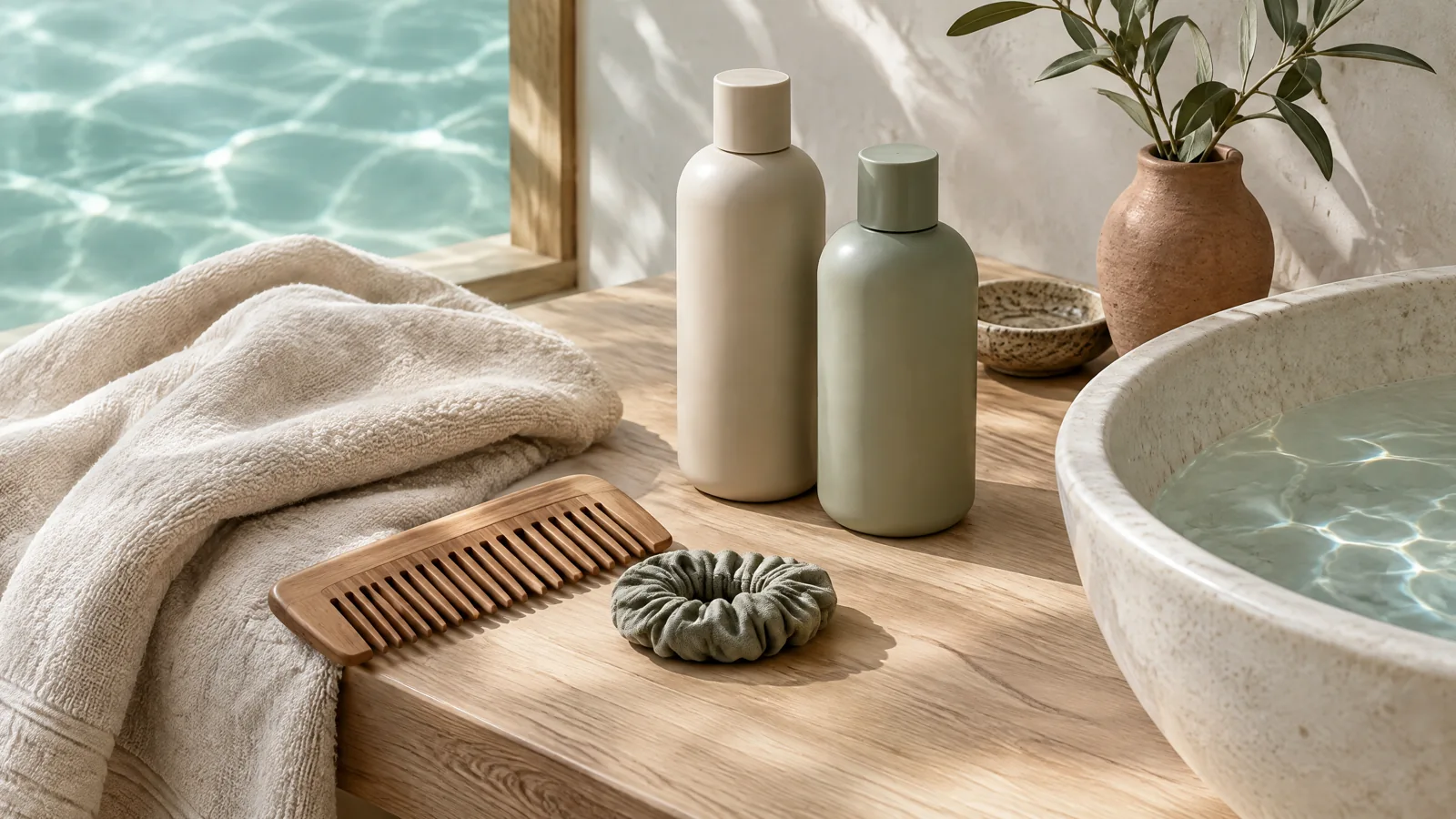
A manageable routine starts with facilities, not a shopping list. Ask whether there will be somewhere suitable to change and rinse after the session, and what facilities cannot be assumed at the meeting point or on the boat. Pack the requested personal items and hair-care products you already tolerate, in containers suitable for the journey. A towel, a bag for wet belongings and a realistic route home may be more useful than adding several unfamiliar treatments. Keep aftercare separate from the equipment briefing so neither conversation gets lost.
For pool swimming, the American Academy of Dermatology recommends rinsing hair immediately afterwards, then washing with a swimmers' shampoo and following with deep conditioner.[2] If your hair is coloured, use Canvas Blend's post-colour hair-care guide to prepare product questions for your stylist. The important question is how to reconcile your treatment's instructions with the expected pool exposure, rather than extending a generic no-wash rule after swimming. No shampoo or conditioner guarantees unchanged colour, and ordinary hair-care advice does not override medical advice about an irritated scalp.
For longer hair, discuss a comfortable arrangement that keeps it from distracting you, and have the instructor confirm actual mask and equipment fit. Do not judge suitability from a photograph or assume that a swimming accessory works with all scuba equipment. Keep oils, petroleum jelly and conditioner away from masks and other gear; hair products are not equipment-fitting solutions. On land, shade or a suitable hat can help reduce sun exposure, consistent with AAD advice.[2] Choose those measures around the day's practical requirements, and tell the instructor promptly if straps, hair or scalp discomfort interfere with participation.
06
How much room should you leave for changed plans or a holiday?
Leave some commitments movable even after a timetable is proposed. DiveHarbour's supplied course information says that dates and meeting arrangements are confirmed individually and that weather or operational arrangements can affect the plan. Ask how updates arrive and what you should do if the plan changes. A spare day in your diary is useful only if an alternative session is permitted and actually confirmed. It does not create an entitlement to make-up teaching, a guaranteed replacement boat day or a refund.
If the course is connected to a future holiday, work back from the trip without making certification by departure a condition that must be met at any cost. Ask the future activity operator about its participation requirements, then discuss an appropriate learning plan with the instructor. Keep flight and post-dive travel questions separate from salon scheduling; obtain qualified guidance rather than applying a personalised flying interval from this article. If training cannot be completed as planned, adjust the holiday activity rather than treating course attendance as proof that all requirements have been satisfied.
An appearance goal can also be revised without making the whole trip a failure. If the colour looks different after repeated water days, note what changed and ask about hair-colour fading solutions before deciding on further processing. Describe the shade, texture and recent exposures instead of requesting an automatic repeat of the original service. This keeps a cosmetic decision proportionate: a fading concern is a reason for a conversation, not a reason to ignore aftercare, hurry training or assume that another chemical treatment is suitable.

07
What should be settled in writing before you pay?
When evaluating a Hong Kong diving school, ask for a reply that connects the route to your experience and availability. Confirm the named course, agency, prerequisites, required sessions, teaching language and how assessment works. Ask who will teach and how supervision is arranged; do not infer qualifications or an instructor allocation from a general page. For groups, give each participant's relevant details rather than assuming everyone needs the same route. A clear reply should identify what has been agreed and what still needs confirmation.
Request the full inclusions and exclusions, including learning materials, equipment, venue or boat arrangements and certification administration where applicable. Then read the payment terms alongside the timetable. All paid DiveHarbour course and activity fees are non-refundable. Make-up sessions are available only under the written terms, with no automatic replacement date. Ask which circumstances qualify, what conditions apply and how arrangements are confirmed. If your work pattern cannot accommodate the possible consequences, waiting to book may be the better decision even when the original proposed dates look convenient.
Obtain any required health paperwork early. Divers Alert Network explains that the Diver Medical Participant Questionnaire identifies health issues relevant to diving and should be answered honestly; when it indicates physician evaluation, that evaluation should be obtained.[3] Swimming confidence is not medical clearance, and an instructor's explanation of course expectations is not a diagnosis. Tell the instructor about discomfort or uncertainty before participation and promptly during training. Seek appropriate medical care for health concerns, and emergency help for urgent symptoms. The useful next step is a complete enquiry, not an attempt to prove that you are ready by yourself.
- State your goal and whether you are new, certified or returning after a break.
- Give participant ages, water experience, preferred learning language and any relevant access needs.
- List dates you can genuinely protect, plus commitments that cannot move.
- Request the course agency, prerequisites, learning sequence, assessment and supervision arrangements.
- Confirm all inclusions, exclusions, meeting details and the method used for updates.
- Ask for the non-refundable payment terms and the exact conditions for any permitted make-up session.
What else should you know about water activities, hair care and planning?
Is an introductory scuba experience the same as certification?
Do not assume so. Ask the provider to state whether the activity is an introduction or a named certification course, what requirements apply and what successful completion awards. Choose according to your learning goal, not just the shorter timetable.
Can online study replace the practical parts of a course?
No. PADI describes knowledge development, confined-water training and open-water training as separate parts of its Open Water pathway.[1] Ask the provider how the selected programme combines study with supervised practical learning; do not assume buying eLearning means all training is booked.
Is a shorter advertised course always better for a busy learner?
Not necessarily. Compare the actual attendance commitment, study deadlines and how additional practice is handled. PADI's Open Water course is performance based, so completion requires demonstrated knowledge and skills rather than attendance alone.[1] A headline duration is not a personal completion guarantee.
How many days after colouring is diving guaranteed to be safe?
This guide cannot give a universal safe waiting period. Discuss the specific treatment, hair and scalp condition, expected exposure and product instructions with the relevant professionals. A fixed delay or protective product cannot eliminate allergy risk or provide medical clearance.
Should I avoid cleaning coloured hair after a pool session?
Do not treat a generic colour-maintenance rule as a reason to leave pool exposure unaddressed. AAD recommends rinsing after swimming and appropriate cleansing and conditioning.[2] Ask your stylist how to reconcile that advice with the instructions for your specific treatment and products.
Are DiveHarbour fees refundable if my schedule changes?
All paid DiveHarbour course and activity fees are non-refundable. Make-up sessions are available only under the written terms; an alternative date is not automatic or guaranteed. Obtain and understand those terms before payment, including how changed arrangements are handled.
Who decides whether a health concern requires medical clearance?
Follow the applicable screening process and obtain physician evaluation when indicated. DAN advises answering the questionnaire honestly and consulting a physician when required.[3] Neither Canvas Blend, this article nor a discussion of your swimming confidence provides individual medical clearance.
What is the next step for travel and hair-care planning?
Choose a course you can give attention to, not merely one you can squeeze between appointments. Start with the learning outcome, obtain the proposed sequence and test the whole commitment against your ordinary week. Then arrange hair-colour decisions around the likely water exposure and your actual hair and scalp condition. A delayed colour change or a later training period may be a sensible compromise; neither means you have abandoned the goal.
Your next step is to send one focused enquiry with your experience, aims and realistic availability. Compare the confirmed agency pathway, inclusions and written terms before paying. Keep health questions with qualified medical professionals and equipment decisions with the instructor. Once the arrangements are clear, a simple aftercare plan and fewer non-movable commitments will give the new activity a more workable place in your routine.
From root touch-ups to pre-wedding colour planning, use hair colour price Hong Kong as an initial reference and discuss your current hair condition before confirming the service.
Sources and editorial notes
- [1] PADI — Become a Certified Scuba Diver FAQs
- [2] American Academy of Dermatology — Must-try summer hair care
- [3] Divers Alert Network — Health Status Overview
This AI-assisted Canvas Blend editorial guide is not a real-client or travel record and is not an independent review. Canvas Blend and DiveHarbour share the same owner; resource links are not independent third-party endorsements. It was not written or reviewed by Vit So in the capacity of a diving instructor; his salon experience does not establish diving-teaching qualifications. It covers water activities, hair care and travel/course planning, not diving instruction, emergency procedures or personal medical clearance. Ask a qualified medical professional about individual medical fitness, and obtain technical training from a qualified instructor. Confirm current external course fees, dates, terms and eligibility directly with DiveHarbour. DiveHarbour’s written terms provide no refunds; only eligible make-up arrangements may be considered under those written terms, with no guaranteed make-up session. Canvas Blend salon enquiries and DiveHarbour external course enquiries, payments and bookings must be handled separately.
Canvas Blend editorial, AI-assisted. Canvas Blend is a hair-colour salon and shares ownership with DiveHarbour; this article is not an independent review. It is course and routine-planning information, not instructor training or medical advice. No personal dive experience, instructor authorship or review by Vit So is claimed. Any accompanying AI-created illustration is illustrative, not a photograph of actual facilities. Services, prerequisites, dates, availability, inclusions and written terms require direct confirmation. All paid DiveHarbour course and activity fees are non-refundable; make-up sessions are available only under the written terms.
More Water Activity and Hair-Care Guides
Water, Travel & Hair CareCompare scuba diving course price Hong Kong beyond the headline
Compare Hong Kong scuba course quotes by training scope, equipment, travel time and written terms, with practical budgeting for water days and coloured hair.
Water, Travel & Hair CareHow to book a scuba diving course in Hong Kong without rushing
Plan a Hong Kong scuba course around your learning needs, written booking evidence, travel commitments and realistic post-swim hair care before paying.
 Water, Travel & Hair Care
Try scuba diving Hong Kong: prepare comfort questions, not shortcuts
Prepare for a first Hong Kong try dive with better questions about comfort, supervision, equipment fit, hair care and booking terms—not DIY scuba shortcuts.