Catering × Gifts × Cakes × Floristry × Occasion Styling
Floristry classes: Choose Beginner Skills You Can Practise
Browse original Traditional Chinese celebrations and everyday aesthetics articles →
Choose beginner floristry classes that let you practise flower conditioning, one reliable construction method and simple proportion before tackling elaborate designs. Start with a small vase arrangement for home displays, or a hand-tied bouquet if learning to hold and assemble stems is your main goal; ask for individual correction rather than judging the class by its finished photograph.
A beautiful arrangement made in a classroom is not necessarily a skill you can repeat in your flat. The tutor may have selected every stem, prepared the flowers and rescued the structure before the photograph. There is nothing wrong with an enjoyable creative afternoon, but someone who wants to arrange flowers regularly needs to know which parts they will actually do themselves.
For Hong Kong readers planning a celebration, a gift or a shared creative activity, the useful question is smaller than whether floristry sounds interesting. What should you learn first so that your next arrangement works without the same materials or instructor? This guide recommends a focused sequence and explains when a different starting project makes sense. It is an AI-assisted Canvas Blend editorial guide, not an independent review of YumYum's affiliated florist.
Before lightening through the mid-lengths and ends, read about balayage Hong Kong, assess your current hair condition, and leave time to discuss a simple at-home care routine.
01
Which skills should beginner floristry classes actually teach?
Begin with three observable outcomes: prepare stems for water, make them stay where you intend, and explain how the flowers relate to the container. These are more useful first targets than producing a large number of designs. Iowa State University Extension identifies conditioning, suitable containers and supporting mechanics alongside proportion and balance in its floral-arranging guidance. That combination makes a practical foundation rather than a decorative shopping list. [2]
Use the Y. Florist page for floristry classes as an enquiry starting point, not proof of the session you will receive. Its overview discusses introductory and group formats, but ask which preparation tasks participants perform and whether they can retry a construction step. Current dates, instructors, language, location and material inclusions require direct confirmation; a general page does not establish a particular booking.
A useful class description should distinguish demonstration from supervised practice. Watching someone condition a bucket of flowers is different from preparing your own stems and having the tutor explain a mistake. Likewise, assembling one successful arrangement is different from understanding why it holds. Ask for a small learning objective you can demonstrate, such as placing a focal flower without the surrounding stems falling outward.
For a social session, learning depth is only one consideration. Some groups prefer an accessible project with time to talk, while another group wants technical feedback and a quieter pace. Canvas Blend's team-building aesthetic experience guide offers a related way to frame the purpose of a shared activity. Decide whether the priority is participation or independent skill before asking a florist to shape the session.
Choose a repeatable task, not merely an impressive take-home object.
02
Why should conditioning come before colour?
Conditioning means preparing cut flowers before arranging them so that they take up water and remain suitable for display. The Royal Horticultural Society recommends removing foliage below the waterline, making clean fresh cuts and allowing prepared stems to drink in clean water in a cool place. Its general guidance allows at least two to three hours, ideally overnight, while recognising that particular plants have additional requirements. [1]
That matters when comparing classes. A short session may reasonably use preconditioned flowers so participants can spend time designing. The trade-off is that you might leave without having practised the preparation itself. Ask whether the tutor can demonstrate on a spare stem and explain the actual flowers used. Do not assume that every plant follows the same treatment, or attempt specialist hot-water methods without appropriate instruction. [1]
At home, keep the routine modest: start with a clean container, remove submerged leaves and use suitable clean cutting tools as demonstrated by the tutor. RHS advice supports sharp tools that avoid crushing stems and also recommends gloves when handling flowers because some plants are poisonous or irritating. Tool handling and plant identification belong in the lesson, not as an afterthought once everyone is already holding materials. [1]
Resist the temptation to turn vase care into a household-ingredient experiment. For a beginner, a commercial cut-flower preservative used according to its instructions is a clearer starting point. Iowa State advises against substitutes such as aspirin and pennies, while RHS recommends cut-flower food and regular water maintenance. Neither source guarantees a fixed vase life for your arrangement; flower condition, species and display environment still matter. [1] [2]
03
Should you start with a vase or a hand-tied bouquet?
Choose a vase project if your main aim is a repeatable arrangement for a shelf or small dining table. The container supports the work while you concentrate on placement. Iowa State notes that straight-sided vases support stems better than flared rims and describes tape grids and other mechanics that help hold flowers in place. Learning with support is not cheating; it makes the relationship between container and stem visible. [2]
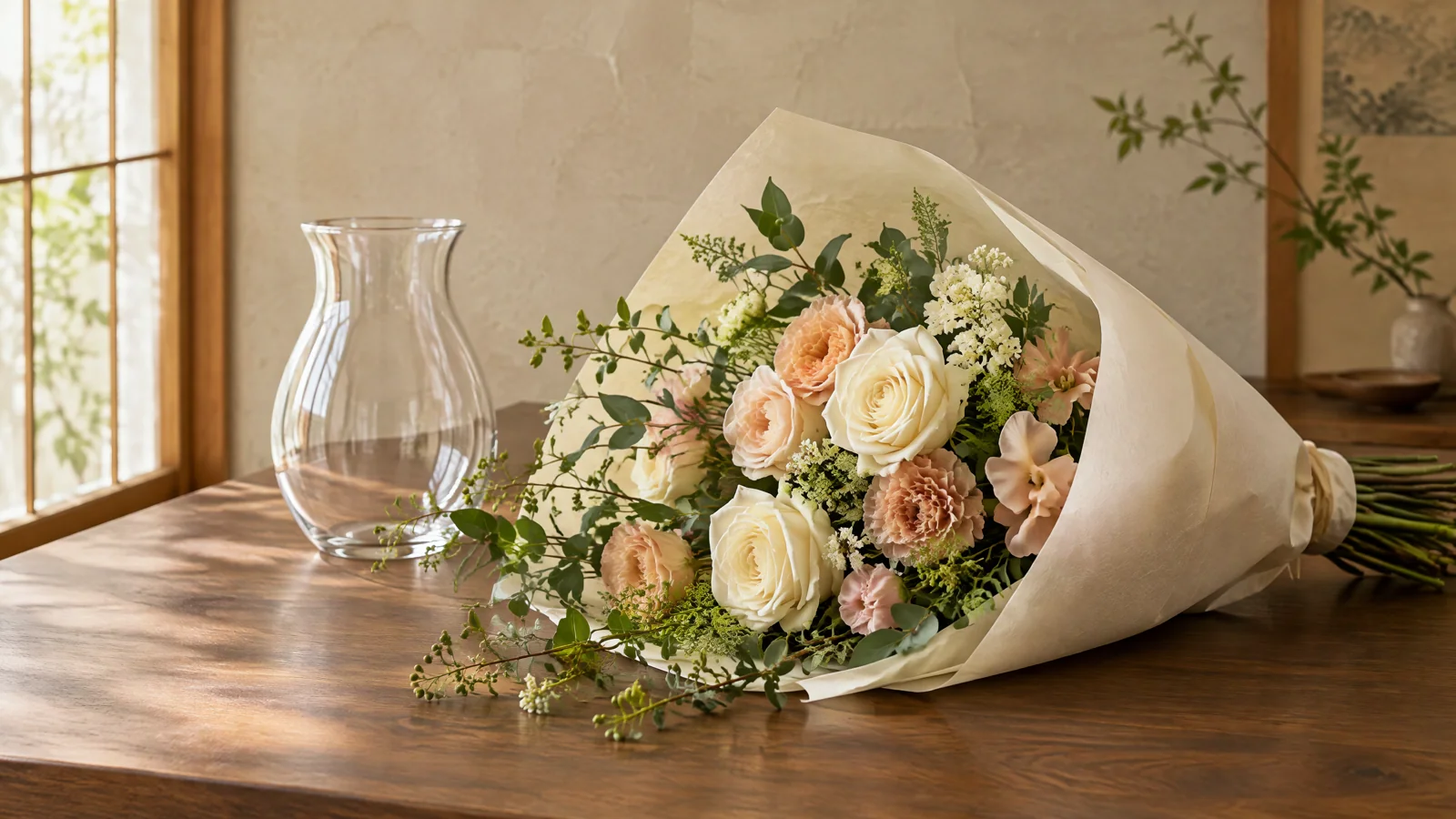
Choose a hand-tied project if you specifically want to practise grip, angled stem placement and viewing a bouquet from different sides. Iowa State describes adding stems gradually in a gentle spiral and turning the bouquet to maintain balance. That introduces another coordination task alongside composition. A beginner who struggles to hold the bunch may benefit from repeating a small build rather than being given more flowers to conceal the difficulty. [2]
The bouquet making workshop page identifies a relevant enquiry route, but its promotional wording is not evidence of teaching quality or a detailed syllabus. Before choosing it, ask whether participants practise the grip themselves, can restart with fewer stems and receive correction before wrapping. Do not infer a confirmed project size, flower selection or instructor qualification from reference images or general enthusiasm.
There is also a mechanics trade-off. Floral foam can hold stems in precise positions, but Iowa State describes it as single-use and non-compostable. A reusable vase is a sensible first choice when the goal is ordinary home arranging. That is not a claim that every foam-free method is environmentally superior in every respect; it simply avoids making a consumable support essential to repeating your first exercise. [2]
| Starting project | Main practice value | Trade-off to accept | Ask the tutor |
|---|---|---|---|
| Small straight-sided vase | Placement, scale and water care | The container provides support, so grip is not the focus | Will I choose stem heights and place the flowers myself? |
| Small hand-tied bouquet | Grip, angled stems and all-round balance | Handling can compete with attention to composition | Can I restart the spiral with a smaller bunch? |
| Structured foam arrangement | Precise placement in a fixed support | The foam is single-use and cannot be composted [2] | How would I repeat a similar design in a reusable vessel? |
04
How can you practise colour without buying more flowers?
Reduce variables rather than buying a wider selection. For the first repeat at home, choose one main colour family and let foliage provide a separate texture. Iowa State explains monochromatic schemes as different tones or values of one colour, and defines proportion through relationships between the components. Limiting colour lets you notice whether height, spacing or flower size is causing the design to feel unsettled. [2]
Then choose where you want the eye to go. A focal flower does not have to be the most expensive stem; its size, position or contrast can make it dominant. Negative space is the unoccupied area between materials, not automatically a gap that needs filling. Both ideas appear in Iowa State's design guidance. Practise leaving an opening deliberately before deciding that the arrangement needs more filler. [2]
If you enjoy looking at colour references across different media, Canvas Blend's hair colour gallery can help you articulate a preference for softer contrast or a more pronounced accent. This is a visual-language exercise, not a florist portfolio. A salon photograph cannot tell you which seasonal flowers are available, and a floral palette cannot predict how hair colour will develop on an individual person.
The same separation applies if you are exploring balayage for your own celebration look. You might like a gradual visual transition in both hair and flowers without asking either professional to copy the other medium literally. Save the overall mood, then describe the actual floral goal to the tutor: a restrained palette, a clear focal area, or a lighter arrangement with visible space.
If longer intervals between colour appointments appeal to you, read about babylights Hong Kong and discuss regrowth, upkeep, and your preferred level of brightness during consultation.
05
What should the room and flower choices rule out?
Start with the destination, not only the classroom. Identify where the arrangement will stand and whether the vessel is practical there. RHS advises a cooler position away from heat, and Iowa State recommends avoiding heat and drafts while checking water daily. For a Hong Kong flat or office, that means looking at the actual display spot rather than assuming a sunny window or an air-conditioning outlet is suitable. [1] [2]
Pet restrictions can override an otherwise attractive project. The FDA warns that true lilies and daylilies are extremely dangerous to cats, including their pollen and vase water, and recommends not bringing these plants into a home with a cat. Tell the organiser about a cat household before materials are selected. A high shelf is not a substitute for excluding those flowers from the take-home arrangement. [3]
Do not treat a lily-free arrangement as automatically safe for every animal. Ask for the names of all flowers and foliage, and check uncertain choices with a veterinarian or an authoritative plant-toxicity resource for the relevant species. If lily exposure is suspected, contact a veterinarian immediately rather than attempting home treatment. The FDA warning supports prompt professional attention, not a do-it-yourself response or reassurance based on appearance. [3]
Personal sensitivities deserve a separate conversation. RHS notes that some cut flowers can irritate skin, so a tutor should be able to identify the supplied materials and explain handling precautions. If you have a diagnosed allergy or a medical concern, ask an appropriate qualified clinician about participation. A promised substitution or the absence of a strong fragrance does not establish that a class is suitable for you. [1]
06
How do you practise again without simply copying the tutor?
Here is a hypothetical example, not a customer story: a beginner wants flowers for a small table at home and has one straight-sided vase. They choose a class that includes conditioning and supported vase placement, even though another option advertises a larger bouquet. Their decision favours a method they can repeat in the vessel they already own over the appeal of a more dramatic first photograph.
For the next attempt, they keep the container and broad design goal but accept different available flowers. They ask which stems can play the focal role and which provide support, rather than demanding an exact shopping list. They change only one design feature, such as lowering the overall height. This is a suggested learning exercise, not a measured programme or a promise about how quickly anyone will improve.
Photograph the arrangement from its intended viewing position and note one decision that worked and one that did not. A useful note says that the wide bloom displaced its neighbours or that the foliage concealed the focal area; a less useful note merely says the result was not pretty. Iowa State distinguishes scale, balance and dominance as separate design principles, giving you concrete language for the next question to a tutor. [2]
Aftercare is part of that review. Check the water and remove deteriorating flowers rather than judging the design only on the day it is made. RHS recommends refreshing water and recutting stems regularly, while Iowa State suggests making a smaller arrangement from sound remaining flowers when the original loses its appeal. Account for the construction method: do not dismantle a fixed support merely to follow generic recutting advice. [1] [2]
- Write one repeatable goal before enquiring: a stable small vase design or a manageable hand-tied bouquet.
- Ask which preparation and construction steps you will perform, rather than only watch.
- Confirm the flower and foliage names, and disclose household pet restrictions or relevant sensitivities before materials are selected.
- Bring a photograph or measurements of your intended vessel if the tutor agrees that it is relevant.
- During class, request one correction and ask why it improves the structure or composition.
- Record the actual care instructions and confirm an appropriate way to transport the finished work.
- For your next attempt, keep one feature constant and change only one design decision.
07
What evidence should you ask for before choosing a class?
Ask for the planned sequence, not a guarantee of artistic success. A useful response explains preparation, the chosen support method, arranging time and how participants receive feedback. The Y. Florist beginner floral arrangement class page describes conditioning and composition as learning topics. Treat that as the merchant's description, then confirm whether those topics are demonstrated or practised in the specific session available to you.
Compare what makes repetition possible: material names, explanations of substitutions, individual correction and care notes. A certificate may be a record of attendance, but that is different from a recognised qualification. If formal training matters, ask for the awarding body, assessment requirements and evidence of recognition. This guide has not verified any florist credential and does not infer professional competence from a course title or promotional photograph.
For a wedding-related creative afternoon, separate learning from event production. Making a practice bouquet does not establish readiness to prepare all wedding flowers or manage venue installation. Canvas Blend's bridal hair colour service is the relevant route for a separate hair-colour consultation. You can coordinate a shared visual mood while leaving the floral class, wedding flowers and salon plan as distinct decisions with their respective professionals.
Finally, confirm location, teaching language, duration, participant support, tools, containers, transport arrangements and written cancellation terms with the florist. None is established by this article as an included benefit. Use Canvas Blend's booking page only for the salon side of your plans, not to reserve the floral session. Keeping enquiries separate avoids mistaking shared ownership for a combined appointment, package or verified timetable.
What else should you ask about celebration planning and everyday aesthetics?
What is the best first skill to learn?
Learn to prepare flowers for water before concentrating on styling. Then practise one support method and simple proportion. Conditioning and clean-container routines are supported by RHS guidance. [1]
Is a vase arrangement easier than a hand-tied bouquet?
A suitable vase gives physical support while you practise placement; a hand-tied bouquet adds grip and stem-coordination tasks. Choose by your goal rather than assuming one project suits everyone. Iowa State describes both methods and their supporting mechanics. [2]
Should a short class prepare every flower from scratch?
Not necessarily. Using preconditioned flowers can leave more time for arranging. If independent home practice is your priority, ask to practise preparation on some stems and receive care instructions for the actual materials used.
Do I need floral foam to make a stable first arrangement?
No. Iowa State describes alternatives such as a suitable vase, crossed stems or a tape grid. Foam is useful for precise placement but is single-use and cannot be composted. Ask which method you can repeat with your own vessel. [2]
Can I take a lily arrangement home if I keep it away from my cat?
The FDA recommends not bringing true lilies or daylilies into a home with a cat. Pollen and vase water are dangerous too. Request appropriate exclusions in advance and seek veterinary advice for uncertain plant choices; contact a veterinarian immediately if exposure is suspected. [3]
Does finishing a beginner class mean I have a professional qualification?
No. A finished project or attendance certificate does not by itself establish a recognised qualification. If that is your goal, verify the awarding body, assessment and recognition with the course provider before enrolling.
How can you organise styling and supplier arrangements separately?
For a first class, prioritise the skill you want to repeat next week: prepare the stems, support the arrangement and explain one compositional choice. A smaller project with useful correction may serve that goal better than a larger piece assembled mostly by the tutor. Choose a vase for ordinary home placement, or a hand-tied exercise when grip and bouquet construction are the reason you want to learn.
Send the florist that specific goal together with your intended vessel or display setting and any material restrictions. Ask what you will practise and what is confirmed in writing before booking. Keep a simple record of the technique and care instructions, then repeat one controlled variation at home. The worthwhile outcome is a decision you understand well enough to make again, not an exact copy of a classroom photograph.
Before choosing a new colour, review hair colour price Hong Kong alongside your hair length, density, and preferred technique so you can plan the appointment with clarity.
Sources, shared ownership and editorial notes
- [1] Cut flowers: cutting and conditioning — Royal Horticultural Society
- [2] How to Create a Floral Arrangement — Iowa State University Extension and Outreach
- [3] Lovely Lilies and Curious Cats: A Dangerous Combination — U.S. Food and Drug Administration
This AI-assisted guide is produced by Canvas Blend Editorial. It is a celebrations and everyday aesthetics guide, not a real-client, food-tasting, product-use or event record, and not an independent review. Canvas Blend and YumYum share the same owner; resource links are not independent third-party endorsements. It is not personally written by Vit So or reviewed by him as a food, baking, nutrition or floristry expert; his real salon background does not establish qualifications in those fields.
Obtain written confirmation from the supplier for service scope, delivery dates, food ingredients, allergens and cross-contact risks, product or supplier certification, actual availability and applicable terms. Images and general guidance are not evidence of these details. Discuss individual food allergies or health needs with a qualified medical professional. This page promises no price, discount, stock, refund or cancellation arrangement and does not describe external services as a joint salon package. Quotes, deposits, amendments and cancellation/refund arrangements depend on the supplier’s current written terms and individual confirmation.
This is an AI-assisted Canvas Blend editorial guide. Canvas Blend and YumYum share the same owner; the article is not an independent third-party review, a first-hand class report or a real customer case study. The scenario is explicitly hypothetical. Vit So is not presented as a florist, food expert, author or reviewer of this guide. Y. Florist pages are merchant information, not independent verification of teaching quality. Confirm current classes, instructors, locations, materials, substitutions, any credential claims and written booking terms directly with the florist. Any food ingredients or certifications require separate confirmation; seek qualified clinical or veterinary advice for personal medical or pet-safety concerns.
More Celebrations & Everyday Aesthetics Guides
Next day flower delivery: who should receive your Hong Kong gift?
Plan tomorrow's flower handover across Hong Kong with clear receiving contacts, venue access and care arrangements. Prepare a practical enquiry before ordering.
Vase arrangement or hamper: which gift fits a real home?
Choose flowers or a hamper around the recipient’s space, care routine and food needs. Use this home-first guide to prepare a practical florist enquiry.
Rose bouquet portraits: how to choose colour and shape
Choose bouquet colour, shape and wrapping around the portrait you want. Compare roses, sunflowers and tulips, then prepare a clear photographic brief.