Catering × Gifts × Cakes × Floristry × Occasion Styling
Chinese Food Catering: How to Balance a Mixed-Style Shared Table
Browse original Traditional Chinese celebrations and everyday aesthetics articles →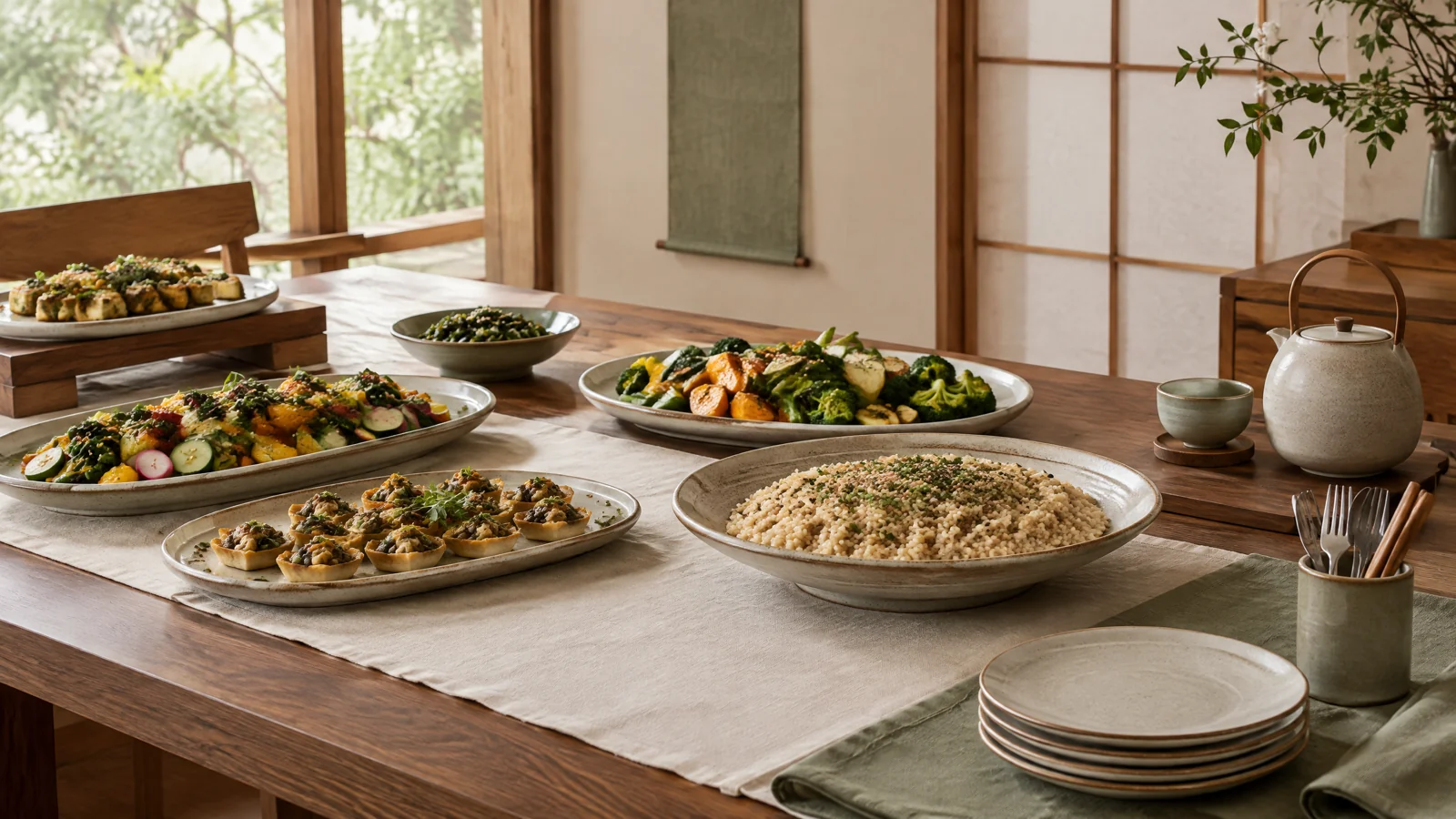
Balance a mixed-style table by choosing one main meal format, then adding dishes that fill a missing role rather than ordering a complete menu from every cuisine. Keep each dish's serving equipment, ingredient information and holding plan separate, even when guests share one table.
A Hong Kong celebration can comfortably include a Chinese sharing meal, a Western main and a few steamed bites. The difficulty is not whether those foods belong together. It is whether they compete for the same appetite, table space and attention. Three attractive menus can become a crowded meal in which guests fill up early and the most carefully chosen dish waits untouched.
For readers planning a family celebration or a company gathering after a creative activity, the useful starting point is the kind of meal people will actually eat. Canvas Blend's team-building aesthetic experience guide can help frame the activity separately. This guide focuses on the shared table that follows, not on claiming that a salon provides catering or that a particular menu improves wellbeing.
If you are searching for hair salon Central, plan a colour visit around meetings or after work, with enough time to discuss tone, upkeep, and your journey from Central.
01
What should make the table feel like one meal?
Choose the dominant dining format before choosing the cuisine mix. A seated sharing lunch needs dishes that guests can portion comfortably from their places. A standing reception needs food manageable with the available plates and cutlery. Neither format becomes more inclusive simply by adding more trays. The real question is whether a guest can assemble a satisfying meal without repeatedly changing how they eat.
Use YumYum's Chinese Food Catering page as a starting reference for Chinese sharing dishes and banquet-style possibilities. It is a merchant category page, not confirmation of your event's final menu. Ask which actual dishes will anchor the meal and how they are portioned; do not assume that every pictured selection, serving arrangement or ingredient will be supplied together.
Give each proposed dish a job in ordinary language: the main shared dish, the staple accompaniment, a vegetable side, an opening bite or the dessert. This makes duplication visible. A bowl of rice and a small bun need not clash, but a substantial rice dish, pasta main and filling dim sum selection may all be competing to provide the same part of the meal.
A coherent Chinese-led table does not require every item to be Chinese. It requires a clear centre and additions that make sense alongside it. If the Western dish is the item most guests want as their main, reverse the emphasis instead of defending the original label. Choosing one centre reduces competing demands on portioning and service while still leaving room for guests to explore.
Choose a meal format first, then assign every dish a distinct purpose.
02
When does a Western dish add value rather than another full meal?
A Western addition earns its place when it supplies something the Chinese-led selection lacks. It might offer a familiar alternative for guests who have stated a preference, or a different texture from the existing soft, sauced dishes. Start with the specific request. Do not presume that age, nationality or appearance predicts what someone will eat, or that everyone needs an alternative main.
The Western Catering category can help you compare pasta, roast-style dishes and accompanying sides as possible additions. Treat those descriptions as options to discuss, not a promise that a full set can be divided or customised. Ask whether the supplier can quote a complementary dish, and whether its stated portion means a main meal or a side serving.
Compare complete plates, not isolated trays. If a guest takes a Chinese main with rice, what would the Western addition change? If it merely adds another large starch portion, a different side may be more useful. If the alternative is intended for guests who will not eat the main, it needs its own adequate accompaniment rather than relying on a shared dish they may also avoid.
There is a real trade-off between familiarity and variety. A familiar alternative can help guests feel considered, but stocking two complete meal systems uses more equipment and creates more leftovers to manage. An agreed alternative for a known group is usually a clearer planning decision than a second full spread purchased because somebody might want it. Confirm those preferences before fixing quantities.
| Approach | What it achieves | What you give up or must confirm |
|---|---|---|
| Chinese-led meal with one Western addition | Keeps a recognisable sharing meal while offering a contrast | Less breadth; confirm that the addition is quoted as a side or alternative main |
| Two distinct main-meal choices | Responds to confirmed guests who want different meals | More holding equipment and separate quantity planning; avoid counting everyone for both |
| Dim sum opening round followed by shared mains | Creates a clear welcome moment before the meal | Requires storage and a reliable handover; the opening round affects appetite for the mains |
03
Should dim sum be the welcome bite or part of the main spread?
Decide whether dim sum is the meal, an opening round or a small accompaniment. These roles imply different quantities and different expectations. A guest arriving for a substantial lunch may treat a tray of dumplings as the beginning of that lunch, not as an extra snack. If you order it on top of a complete meal without explaining the sequence, early servings can change what remains popular later.
Explore Dim Sum Catering for the yum cha-style format, then request the actual piece count, item size and serving advice for the selection you are considering. The category name does not make every item a convenient standing bite. Check whether guests will need chopsticks, a fork, a bowl or a place to sit, especially when the item is sauced or requires dividing.
For a short welcome round, choose a limited selection and signal that the main meal follows. For a continuous shared lunch, make dim sum part of the main quantity discussion rather than treating it as invisible extra food. Ask the caterer how the selected pieces relate to the rest of your order. A piece count helps procurement, but it does not by itself establish a full meal portion.
Separate rounds are not automatically the better choice. They give each course attention, but someone must look after the waiting food and reset the service area. If the venue cannot support that handover, a smaller simultaneous spread may be more practical. Hong Kong's Centre for Food Safety recommends displaying small portions and replacing them with fresh batches rather than topping up an existing batch.[1]
04
How can one table accommodate different textures and serving styles?
Arrange the table around how food is served, rather than creating a Chinese corner and a Western corner solely for appearance. Keep each dish with its own appropriate serving utensil and enough room for the lid or cover. Place sauces where their purpose is clear. Guests should not have to move another dish's tongs or reach across a tray to finish assembling their plate.
Ask what equipment the selected food actually needs. A roast-style item may involve carving or a different serving tool; a sauced dish needs a pan that allows clean portioning. Do not assume that one tray shape or warming method suits every dish. The caterer should explain which elements arrive ready to serve, which require staff attention and what the venue must provide.
Visual variety matters, but a full table is not the same as a usable one. Reserve space for clear labels and for people to put down a plate while serving. For a celebration that also includes portraits, use the Canvas Blend gallery as a separate hair-colour reference for a consultation. Hair inspiration and tabletop presentation can share an event brief without turning either into evidence about the other's suitability.
Make the table attractive through a restrained layout rather than disguising holding equipment. A neutral cloth and legible dish cards can support different food styles without renaming them as fusion dishes. Photographing the arrangement before guests arrive is a planning preference, not a reason to leave food out early. The holding plan should determine when each dish is brought to the display.[1]
For a look that complements your skin tone and everyday styling, explore hair colour Hong Kong and compare soft dimension, brighter accents and the care each approach involves.
05
What must be settled before hot and cold dishes share a service window?
One shared service window does not mean one shared temperature requirement. The Centre for Food Safety advises keeping hot food above 60°C and cold food at 4°C or below, with suitable equipment preheated or pre-chilled. Its guidance also says precooked food not served immediately should enter appropriate hot or cold holding within two hours. These are operating requirements, not qualities that can be verified from a photograph.[1]
Ask who checks temperatures at the venue, where reserve food is held and when the final display is cleared. An insulated delivery carrier is not, by itself, an agreed plan for the entire event. The same CFS guidance notes that hot-holding equipment is intended for holding already-hot food, not cooking or reheating it. Do not plan to solve an arrival problem by simply putting a cool tray into a warmer.[1]
Timing should include setup and any interval before guests eat. A speech, group photograph or workshop overrun may extend that interval, even when the invitation lists a short lunch. Give the caterer the real sequence and ask for a suitable serving schedule. If that schedule needs refrigeration or additional hot-holding space that the venue lacks, simplify the menu rather than treating the missing equipment as a minor inconvenience.
Keep the plan deliberately conservative. CFS advises short displays, fresh replacement batches and consumption of displayed food within four hours of cooking.[1] That is not permission to put every dish out for four hours at room temperature. If you cannot establish the handling history or required conditions, ask the responsible caterer what can be served; appearance and smell do not establish compliance with a time-and-temperature plan.
06
How do guests know which dishes they can actually eat?
A mixed menu needs information at dish level. CFS lists potential allergenic ingredients in foods such as sauces, pasta, desserts and soy products, and advises food premises to confirm relevant allergens with the cooks.[2] A dish that appears vegetable-based may still involve an ingredient a guest needs to avoid. Ask about the complete recipe, including stock, garnish and accompanying sauce, rather than judging by its main visible ingredient.
The UK's Food Standards Agency recommends separate allergen information for each buffet item and written information supported by a conversation.[3] This is useful practical guidance, not a statement of Hong Kong legal requirements. Request an up-to-date dish sheet before ordering and matching information at delivery, so the host is not improvising labels from memory while guests begin eating.
Vegan is not the same as allergen-free: the FSA specifically warns that cross-contact with animal-derived allergens can occur during production.[3] Vegetarian, gluten-free, halal and organic descriptions likewise answer different questions; none should be treated as proof that every allergen is absent. For any relevant certification claim, request evidence covering the actual food supplied. An attractive image or a cuisine category cannot establish ingredients, certification or cross-contact controls.
Dedicated serving utensils are helpful, but they cannot undo cross-contact earlier in preparation. Ask about kitchen handling and what happens if a guest moves a utensil between dishes; both CFS and FSA stress preventing unintended allergen transfer.[2] [3] For a guest with a severe allergy or personal medical dietary requirement, involve the caterer and the guest's qualified healthcare professional. If suitability cannot be confirmed, do not offer reassurance or assume the shared buffet is appropriate.
07
What would a balanced choice look like for a real planning brief?
Consider a hypothetical family celebration with seated guests, a Chinese-led lunch and a request for a Western alternative. This is an invented planning example, not a Canvas Blend or YumYum customer story. The host initially wants shared mains, a full pasta tray and a broad dim sum welcome spread. Reviewing those choices by role reveals that several substantial dishes are being treated as additions without reducing anything else.
A workable revision is to keep the Chinese sharing meal as the centre, confirm who wants the alternative and quote that alternative as a defined meal choice. Dim sum becomes a modest opening round only if the venue can support its holding and handover. Otherwise, the host selects a smaller amount within the main spread. The sacrifice is variety; the gain is a clearer meal with fewer simultaneous service demands.
If the occasion is a pre-wedding gathering, keep the lunch plan separate from bridal hair-colour planning. A colour consultation needs its own assessment and calendar; a caterer's serving schedule needs its own responsible contact. Shared event dates can be noted in both briefs, but booking one service does not reserve the other, establish a combined package or confirm that guests can dine at the salon.
For a separate personal colour appointment, use Canvas Blend booking to discuss the service and availability, not to place a food order. The Vit So profile concerns hair-industry experience and colour design; it is not a food-safety qualification or evidence that he reviewed this guide. Send the catering contact a dish-role brief and obtain written confirmation of quantities, equipment, ingredients and terms before committing.
- Write down whether guests will sit or stand and whether the food replaces a meal or follows one.
- Assign every proposed dish a role; remove an addition that only duplicates an existing substantial dish.
- Confirm actual piece counts or stated servings, and identify who will take an alternative main rather than both meals.
- Request dish-level ingredient and allergen information, cross-contact details and any relevant certification evidence.
- Agree hot and cold holding, reserve storage, replacement batches and the person responsible for checks and clearing.
- Confirm the final menu, supply date, minimum order, handover arrangements, equipment, fees and change terms in writing.
What else should you ask about celebration planning and everyday aesthetics?
Does a mixed-style table need equal amounts of Chinese and Western food?
No. There is no useful universal cuisine ratio. Choose the main meal format, confirm alternative-meal demand and assess the role and stated serving size of each dish. Equal tray counts can still mean very unequal meal quantities.
Can dim sum count toward lunch rather than being an extra snack?
Yes, when it is planned as part of the meal. Ask about the actual item sizes and quantities alongside the shared mains. Do not assume that a stated number of pieces defines a complete lunch portion.
Is it safer to bring every dish out in separate rounds?
Not automatically. Separate rounds require suitable storage for waiting food and someone to handle the changeover. A smaller simultaneous spread may be easier to operate. Both formats still need appropriate holding and short display times.[1]
Can a warming tray reheat a dish that has cooled during delivery?
Do not plan on that. CFS states that hot-holding devices are not intended for cooking or reheating. Ask the caterer for the appropriate arrival and holding procedure for the actual dishes and equipment.[1]
Is a vegan dish automatically suitable for someone with a milk allergy?
No. The FSA warns that vegan food can have allergen cross-contact during production. Confirm ingredients and handling with the caterer, and obtain qualified advice for an individual's severe allergy or medical requirements.[2] [3]
Does this guide independently endorse YumYum or offer a combined salon-and-food booking?
No. Canvas Blend and YumYum share ownership, and this is an AI-assisted editorial planning guide, not an independent review. Catering and salon arrangements must be confirmed separately with the intended business.
How can you organise styling and supplier arrangements separately?
The most useful mixed-style table is not the one with the longest menu. It is the one where guests understand what is being served, can put together a satisfying plate and do not have to navigate avoidable duplication. Keep the Chinese-led meal coherent, use the Western addition for a specific need and give dim sum a deliberate place in the sequence.
Your next enquiry should describe the meal and its constraints before requesting a package. Name the dining format, the role of each dish and the known guest requirements, then ask the supplier to confirm the practical serving plan. Be willing to remove one appealing item when it adds another storage problem or competes with the main meal. That is a considered choice, not a less generous celebration.
For hair that looks dry, frizzy, or prone to breakage in a photo, read about damaged hair treatment Hong Kong to help frame questions for a colour-care consultation.
Sources, shared ownership and editorial notes
- [1] Centre for Food Safety — Hot / cold holding and display
- [2] Centre for Food Safety — Food allergens
- [3] Food Standards Agency — Allergen guidance for food businesses
This AI-assisted guide is produced by Canvas Blend Editorial. It is a celebrations and everyday aesthetics guide, not a real-client, food-tasting, product-use or event record, and not an independent review. Canvas Blend and YumYum share the same owner; resource links are not independent third-party endorsements. It is not personally written by Vit So or reviewed by him as a food, baking, nutrition or floristry expert; his real salon background does not establish qualifications in those fields.
Obtain written confirmation from the supplier for service scope, delivery dates, food ingredients, allergens and cross-contact risks, product or supplier certification, actual availability and applicable terms. Images and general guidance are not evidence of these details. Discuss individual food allergies or health needs with a qualified medical professional. This page promises no price, discount, stock, refund or cancellation arrangement and does not describe external services as a joint salon package. Quotes, deposits, amendments and cancellation/refund arrangements depend on the supplier’s current written terms and individual confirmation.
An AI-assisted Canvas Blend editorial planning guide. Canvas Blend and YumYum share ownership; this is not an independent third-party review, a tasting report or a real customer case. Vit So is not presented as the author, reviewer or a food or floristry specialist. Confirm actual supply, ingredients, allergen handling, certification evidence, minimum orders, delivery or collection arrangements, fees and written terms with the relevant business. Individual medical dietary needs require qualified professional advice.
More Celebrations & Everyday Aesthetics Guides
Japanese Catering: Should You Choose Cold Platters or Cooked Dishes?
Compare cold platters and cooked Japanese dishes by guest needs, holding equipment and event flow. Build a practical menu brief before requesting a quote.
Seafood Catering: Which Requests Need More Than a Menu Swap?
Separate seafood preferences from allergies, vegan choices and gluten-free requirements. Use a practical menu check before confirming your Hong Kong event.
Halal Catering: Better Questions for Your Wedding Suppliers
Plan an inclusive Hong Kong wedding menu by checking halal evidence, allergens and service handovers. Use these questions before confirming suppliers.