Catering × Gifts × Cakes × Floristry × Occasion Styling
Buffet Catering: Match Platters to Your Actual Table Space
Browse original Traditional Chinese celebrations and everyday aesthetics articles →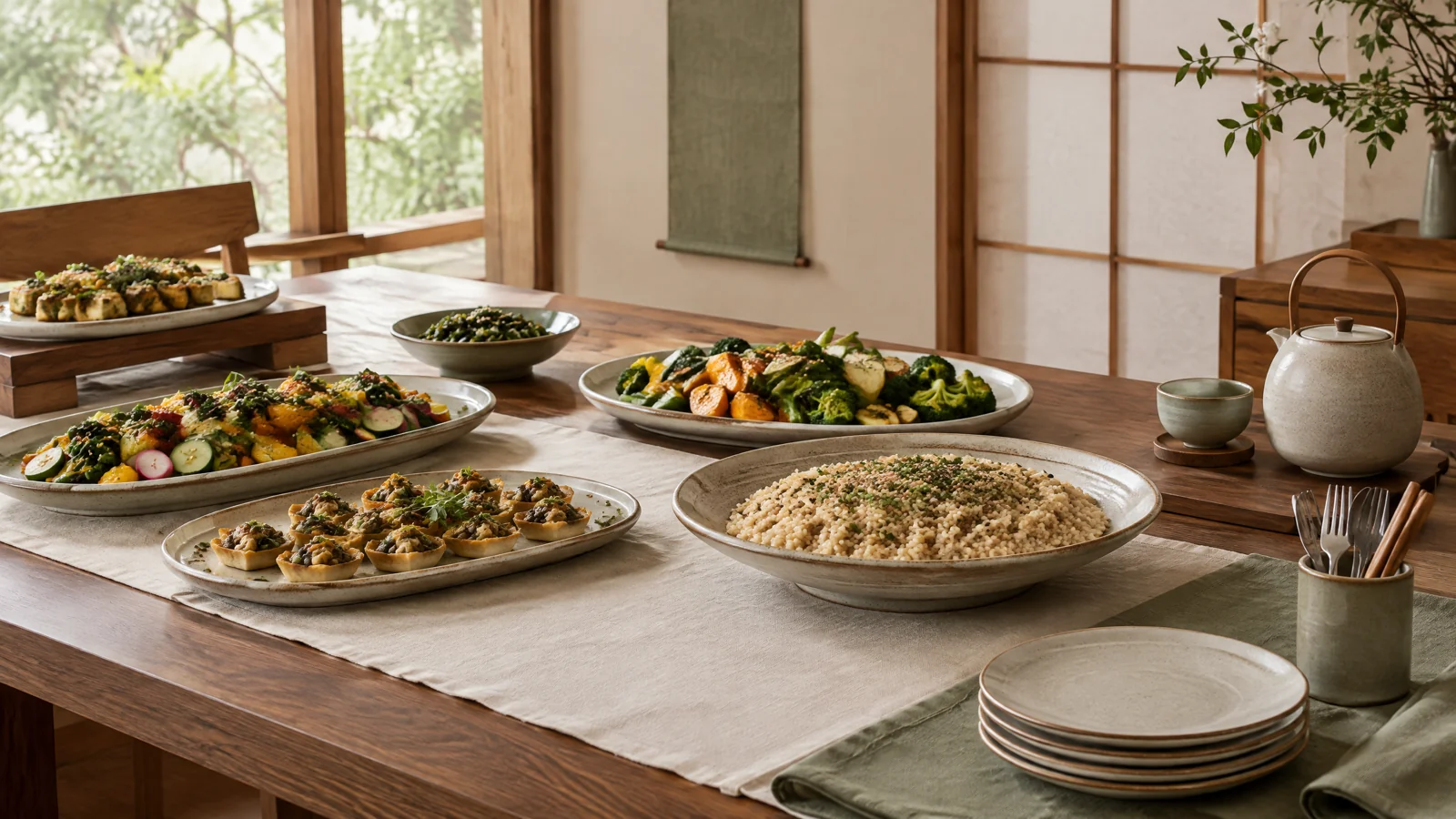
Choose buffet platters by the usable serving space left after equipment, utensils and guest access are accounted for, not by the table's advertised size. If the complete setup does not fit, reduce simultaneous dishes or change the serving format rather than squeezing trays into the walking route.
A menu can look manageable on a screen and still overwhelm the table available at an office celebration or private gathering. The missing detail is usually not the food itself. It is the stand beneath a hot tray, the chilled container around a cold platter, or the place where someone must set down a plate while serving.
For Canvas Blend readers planning a wedding-related gathering or a company social, the useful question is practical: which food format can this room support? Treat the buffet as a working arrangement rather than a decorative photograph. Guests need to identify dishes, serve themselves and move away, while the person replacing food needs access without reaching across them.
The approach below separates three decisions that are often bundled together: how much food to order, how much to display at once, and how to hold the rest safely. They are connected, but one does not automatically answer the others. A smaller visible selection can work well only when the remaining portions have suitable storage and someone responsible for replenishment.
If you are searching for hair salon Central, plan a colour visit around meetings or after work, with enough time to discuss tone, upkeep, and your journey from Central.
01
What counts as usable buffet table space?
Start with the exact surface that the venue has agreed you can use. Measure its length and depth, then note anything that cannot move: a column beside it, a nearby door swing or a fixed counter appliance. A wall-backed table offers a different serving arrangement from a freestanding one. Do not count the inaccessible back edge as useful guest access simply because it appears on your sketch.
Next, mark the non-food positions before fitting platters. Plates, serving utensils, dish labels and a controlled handover position all use space. Drinks can create a separate pause while people choose, pour and carry them. Moving drinks elsewhere may help, but only if that second location has its own usable surface and does not create a new obstruction. The floor plan matters as much as the tabletop.
Use Buffet Catering as a menu-format starting point, then request dimensions for the complete proposed setup. Ask whether the quoted footprint includes holding equipment, lids and utensil rests, rather than just the food container. A menu page does not establish that the equipment will fit your venue or that setup labour is included; those details belong in the written proposal.
If food follows an aesthetic workshop, the Hong Kong team-building aesthetic experience guide can help you consider the wider activity plan. Do not automatically reuse an occupied workshop table as the buffet station. Confirm when it becomes available and who clears and prepares it. The catering layout should be drawn for the actual eating period, not an earlier photograph of an empty room.
02
Will a mini buffet actually solve the space problem?
A compact format helps when it reduces the number of dishes or equipment units displayed simultaneously. It does not help merely because the order serves fewer people. A smaller portion inside the same stand can occupy almost the same space. Ask for container sizes and the intended serving arrangement before treating a package name as evidence that it suits a narrow table.
When exploring Mini Buffet Catering, compare the proposed number of active serving positions with your sketch. A focused meal built around fewer shared dishes may leave more room for utensils and orderly service. The trade-off is less simultaneous choice. Decide which dishes are essential to the meal, rather than assuming every optional side needs its own permanent place on the table.
Replacing one large display with smaller batches can free working space, but it also creates a storage and staffing requirement. Hong Kong's Centre for Food Safety recommends displaying food in small portions and refreshing the display with completely fresh batches, rather than topping up an existing batch. [1] The practical benefit depends on having somewhere suitable to hold replacement food before it reaches guests.
If there is no appropriate holding area and nobody can manage replacements, a smaller display is not a complete solution. Consider a simpler menu, a shorter clearly managed serving period, or a different meal format agreed with the supplier. The decisive constraint may be back-of-house capacity rather than table length. A compact buffet should reduce operational demands, not conceal them behind smaller-looking plates.
03
How can you test whether the platters fit before ordering?
Make full-size paper outlines of the proposed equipment and place them on the actual table, with the venue's permission. Include separate markers for plate stacks and utensils. Test the position with a lid open and a person holding a plate, not just with neatly closed containers. The aim is to find conflicts while changes are easy, rather than discover them when the delivery arrives.
Consider a hypothetical gathering with one table measuring 180 by 75 centimetres. Assume the plan reserves 25 centimetres of length for plates, 15 for labels and utensils, and 20 for a handling position. That leaves 120 centimetres for a single equipment row. These are illustrative allocations, not recommended safety clearances, standard equipment sizes or a specification supplied by YumYum.
Suppose each proposed holding unit occupies 45 centimetres along that row, with an illustrative 10-centimetre gap between units. The Python-calculated comparison below shows that two units occupy 100 centimetres, while three occupy 155. This establishes only a provisional length fit. Depth, lid movement, heat-source requirements, table stability and the guest route still need checking before the arrangement is accepted.
In this example, reject the third simultaneous unit rather than borrowing the handling position or extending into the aisle. Ask whether a dish can be replaced later under a safe holding plan, or remove a dish that duplicates another meal role. For presentation inspiration, the Canvas Blend hair colour gallery is a separate aesthetic reference, not a guide to catering dimensions; keep visual choices subordinate to the measured layout.
| Layout item | Assumed or calculated length | Decision consequence |
|---|---|---|
| Table length | 180 cm | Depth and room access require separate checks |
| Reserved non-food positions | 60 cm in total | Keep these positions in the plan |
| Available equipment-row length | 120 cm | Use as the provisional comparison limit |
| Two 45 cm units with one 10 cm gap | 100 cm; 20 cm remains | Length fits provisionally; other checks remain |
| Three 45 cm units with two 10 cm gaps | 155 cm; exceeds available length by 35 cm | Reduce simultaneous units or redesign the format |
04
Which dishes belong on the same serving station?
Group dishes according to how people serve them and how they must be held, not just their colour or menu category. A hot dish needs appropriate holding equipment; a chilled platter may need a cold-holding arrangement larger than the platter itself. The Centre for Food Safety specifies hot holding above 60°C and cold holding at 4°C or below, with suitable equipment prepared before use. [1]
For Food Platter Delivery, request the outer dimensions of the delivered platters and clarify whether they are intended for direct display or transfer into another setup. A photograph of sandwiches or fruit cannot establish the required holding conditions. Ask the supplier for instructions specific to the actual dishes, delivery timing and proposed service period rather than assuming every cold-looking platter has the same requirements.
Arrange the visible sequence so guests can collect a plate, recognise a dish and use its utensil without reaching over another container. Keep frequently needed utensils easy to locate. If a dish requires substantial assembly, carving or a separate sauce operation, decide whether that action belongs at the main table. Moving it can simplify service, but only with a suitable second position and someone able to manage it.
Ingredient information also needs a physical place in the arrangement. CFS warns that allergens may be hidden in dishes and that inadequately cleaned utensils or hands can cause allergen cross-contamination. [4] Ask for confirmed ingredient information and dedicated serving utensils, while recognising that these alone do not guarantee an allergen-free meal. Guests with serious allergies should discuss suitability with the supplier and a qualified healthcare professional before relying on a shared buffet.
For a look that complements your skin tone and everyday styling, explore hair colour Hong Kong and compare soft dimension, brighter accents and the care each approach involves.

05
Where will replacement trays wait before service?
Draw a second plan for food that is not yet on display. Specify the holding location, the responsible person and the route used to bring a replacement dish to the table. Do not treat delivery boxes under the table as an automatic solution. Packaging and spare surface area do not establish temperature control, and a hidden pile can make access and collection harder.
CFS advises using preheated hot-holding equipment and adequately pre-chilled cold-holding equipment, with temperature checks. It also states that hot-holding devices are not suitable for cooking or reheating food. [1] Ask who will receive the delivery and confirm the food's handling instructions. A buffet stand should not be treated as a way to rescue food whose condition or holding history is uncertain.
Use whole-dish replacement rather than repeatedly mixing newly supplied food into an old serving dish. Both CFS and the US Food and Drug Administration support replacing displayed food with fresh batches; the FDA also recommends small serving platters with appropriately stored backups. [1] [3] Here, the FDA supports the replacement principle, while the Hong Kong CFS guidance supplies the local holding temperatures cited in this article.
Give the replenishment person a practical trigger for checking each dish, such as scheduled observations agreed in the service plan, rather than an unsupported promise that trays will always look full. Record the relevant times and temperatures as directed by the supplier's food-safety procedure. If safe replacement cannot be maintained, simplify the display. Abundant-looking food is not a reason to keep uncertain food in service.
06
What must the caterer and venue confirm separately?
The supplier can confirm proposed food containers, equipment and service arrangements; the venue must confirm what the room permits. Those answers need to meet in one plan. A caterer may offer a holding unit that the venue cannot accommodate because of electrical arrangements or restrictions on heat sources. Do not make an improvised substitution on the day without agreement about its suitability.
Use Catering Services to compare alternative formats if the first layout fails, then request an itemised proposal tied to your measured space. Separate food portions from equipment hire, setup, replenishment support and collection. Confirm availability, delivery access and written terms directly. This guide does not independently verify YumYum's prices, ratings, delivery speed, certification or package inclusions, and none should be inferred from a menu illustration.
Check the guest route after the table layout is drawn. HSE's event guidance says pedestrian routes should be clear and queues should not block emergency access routes. [2] This is a useful planning principle, not a Hong Kong statutory aisle-width specification. Ask the venue which routes and clearances must remain available, and test whether a waiting guest could leave the queue without obstructing others.
Finally, walk through receiving, serving and clearing as separate activities. Where will packaging be removed? Can a replacement tray reach the table while people are eating? Where will used items wait for collection without occupying the food station? Assign these tasks by name. A layout that works only when every guest stands still and every container remains unopened is not yet a workable service plan.
- Record the agreed table dimensions and mark the permitted guest approach on a simple sketch.
- Request the full outer footprint of each platter and holding unit, including lid movement and required operating clearances.
- Reserve positions for plates, utensils, dish information and replacement handling before adding optional dishes.
- Confirm heat-source permissions, electrical arrangements and suitable storage for food awaiting display.
- Name the people responsible for receiving food, checking holding conditions, replacing dishes and clearing the station.
- Obtain written confirmation of portions, equipment, staffing, delivery access, collection and the venue-approved layout.
07
How can the buffet look considered without becoming crowded?
Use a restrained presentation after the working positions are settled. Clear, readable dish information and consistent serving pieces can create coherence without another display object between every tray. Place purely decorative items elsewhere if they compete with serving access. Avoid adding height simply for a photograph when it makes a lid harder to open or a dish harder to identify.
For a wedding-related celebration, coordinate the room's visual mood with personal styling without expecting the buffet to carry every design detail. The bridal hair colour service belongs to the styling conversation; the food layout belongs to the venue and catering discussion. Keeping those responsibilities distinct helps the host make a cohesive plan without treating a salon as a food-safety adviser.
Keep the budgets distinct too. If salon services form part of the occasion, consult the Canvas Blend pricing page for that separate decision, then assess the catering proposal against its own food and equipment scope. Money saved by excluding a decorative piece may be more useful for necessary holding equipment or service support. The better trade-off is a workable meal, not the greatest number of visible platters.
If appointments and food service share a celebration schedule, use the Canvas Blend booking page to discuss the salon portion separately, without assuming availability or permission to serve food on salon premises. Confirm the host venue's rules before connecting the two plans. This article is an AI-assisted Canvas Blend editorial guide, not an independent review: Canvas Blend and YumYum share an owner, and the example above is hypothetical.
What else should you ask about celebration planning and everyday aesthetics?
Can I calculate the order from the table size alone?
No. Table size helps determine what can be displayed simultaneously. Total food quantities depend on confirmed diners, the meal's role and the supplier's stated portions. Keep those calculations separate, then agree how any undisplayed food will be held and served.
Does a mini buffet always use smaller equipment?
No. Request the actual container and equipment dimensions. A smaller quantity inside a standard holding unit may save little or no tabletop space; fewer simultaneous units can be the more useful change.
Can I put new food on top of a partly used platter?
Do not plan service that way. CFS and FDA recommend replacing displayed dishes with fresh batches instead of adding new food to the existing dish. Suitable holding space and a responsible replenishment person are part of that plan. [1] [3]
Will an air-conditioned room keep cold platters safe?
Do not assume it will. CFS specifies cold holding at 4°C or below and appropriate pre-chilled equipment. Confirm a dish-specific holding and monitoring plan rather than using the room's comfort level as a food-temperature check. [1]
Can both sides of the table become buffet queues?
Only if the complete layout, utensils and venue-approved routes support that arrangement. Two-sided access is not automatically safer or faster. Check waiting space, replenishment access and emergency routes; do not turn required circulation space into an extra queue. [2]
Can a dietary label replace ingredient confirmation?
No. A vegetarian or other dietary description does not establish absence of every allergen or control of shared utensils. Obtain actual ingredient and handling information; for serious allergies or individual medical needs, seek confirmation from an appropriately qualified healthcare professional. [4]
How can you organise styling and supplier arrangements separately?
Before ordering, send the supplier a measured sketch with reserved non-food positions and ask for the full equipment footprint. Have the venue confirm the proposed route and operating arrangements. If the setup does not fit, first reduce simultaneous serving units or change the format; do not sacrifice the handling position or an essential walking route to preserve an attractive menu image.
The most useful final decision is not whether the table can hold every dish in a photograph. It is whether guests can serve the planned meal while the remaining food is held appropriately and replacements arrive without disruption. Once those conditions are agreed, presentation becomes a finishing choice rather than a constraint that the service team must work around.
For hair that looks dry, frizzy, or prone to breakage in a photo, read about damaged hair treatment Hong Kong to help frame questions for a colour-care consultation.
Sources, shared ownership and editorial notes
- [1] Hot / cold holding and display
- [2] Put crowd controls in place
- [3] Serving Up Safe Buffets
- [4] Beware of Allergens in Food
This AI-assisted guide is produced by Canvas Blend Editorial. It is a celebrations and everyday aesthetics guide, not a real-client, food-tasting, product-use or event record, and not an independent review. Canvas Blend and YumYum share the same owner; resource links are not independent third-party endorsements. It is not personally written by Vit So or reviewed by him as a food, baking, nutrition or floristry expert; his real salon background does not establish qualifications in those fields.
Obtain written confirmation from the supplier for service scope, delivery dates, food ingredients, allergens and cross-contact risks, product or supplier certification, actual availability and applicable terms. Images and general guidance are not evidence of these details. Discuss individual food allergies or health needs with a qualified medical professional. This page promises no price, discount, stock, refund or cancellation arrangement and does not describe external services as a joint salon package. Quotes, deposits, amendments and cancellation/refund arrangements depend on the supplier’s current written terms and individual confirmation.
An AI-assisted Canvas Blend editorial guide. Canvas Blend and YumYum share an owner; this is not an independent third-party review or a report of a real customer event. The table example is hypothetical and its arithmetic was calculated in Python. No food-safety, catering or floristry qualification, authorship or review is attributed to Vit So. Confirm supply, portions, ingredients, allergy handling, any claimed certification, equipment, venue permissions and written order terms directly with the relevant provider. Individual medical or serious-allergy suitability requires appropriately qualified professional advice.
More Celebrations & Everyday Aesthetics Guides
Party Finger Food Catering: How to Protect Your Photo Schedule
Plan finger food around portraits, not the other way round. Compare serving cues, food holding and dessert timing, then build a practical event brief.
Chinese Food Catering: How to Balance a Mixed-Style Shared Table
Build a Chinese-led shared table with Western dishes and dim sum without doubling the meal. Compare serving roles, holding needs and your next enquiry.
Japanese Catering: Should You Choose Cold Platters or Cooked Dishes?
Compare cold platters and cooked Japanese dishes by guest needs, holding equipment and event flow. Build a practical menu brief before requesting a quote.