Water Activities × Hair Care × Travel Planning
Hong Kong diving school: compare confidence, time and care routines
Browse original Traditional Chinese water activity and hair-care guides →
Choose a school whose confirmed teaching plan fits your present water confidence, available study and attendance time, and practical care needs. Compare supervision and assessment before speed, ask about washing and changing arrangements, and read the written inclusions and non-refundable payment terms before committing. A manageable plan matters more than a convenient course label.
A diving course does not occupy only the hours you spend in the water. It also asks for attention before a session, travel to the meeting point and enough time afterwards to change, wash and get home without rushing. For someone balancing work, coloured hair and a holiday calendar, these ordinary details can determine whether a promising course is genuinely workable. The useful question is not which school looks most adventurous, but which confirmed arrangement you can attend and learn from comfortably.
This guide compares personal fit rather than ranking schools. Canvas Blend is a hair-colour salon, not a diving school, and shares ownership with DiveHarbour; the discussion is therefore not an independent review. The examples below are invented planning scenarios, not customer accounts. Hair-care considerations belong alongside your calendar and comfort, but never ahead of training requirements, medical assessment or an instructor's decision about equipment and participation. Start with what you need to learn, then build a routine that supports it.
If your hair feels dry, fragile, or difficult to detangle after lightening, explore damaged hair treatment Hong Kong before planning another colour service or adjusting your home-care routine.
01
What would make a school a good fit for your actual week?
Write down one learning goal and one constraint before browsing a Hong Kong diving school. Your goal might be to discover whether a supervised introduction appeals to you, or to work towards entry-level certification for future recreational trips. Your constraint might be unpredictable shifts, discomfort with unfamiliar equipment or limited time between weekend commitments. Keeping these separate prevents a convenient departure date from becoming the reason you select a route that does not meet your goal.
Consider two hypothetical learners. One works regular hours and wants certification before a future holiday, but needs calm explanations in English. The other is curious about scuba, works changing shifts and has a major hair-colour appointment planned. Neither is automatically suited to the same format. The first needs a realistic learning sequence and attendance plan; the second needs to establish interest and availability before buying a larger commitment. These are examples of different priorities, not judgments about who will learn faster or become a better diver.
For the colour appointment, use Canvas Blend's before-and-after hair-colour planning guide to prepare the salon conversation alongside the course enquiry. Tell your colourist about expected pool sessions rather than assuming the two bookings are unrelated. Then ask the diving provider about its actual session arrangements. A good fit is built from those specific answers, not from a general promise that a busy person can squeeze everything into one weekend. It can be reasonable to move one commitment instead of compressing both.
02
How should you compare learning time rather than advertised speed?
PADI describes its beginner certification pathway as knowledge development, confined-water training and open-water dives. It also says its Open Water course is performance based: progress depends on demonstrating the required knowledge and skills, not simply spending a fixed number of days on a course. These are PADI's published principles, not a guarantee about a local provider's calendar. They explain why the shortest advertised timetable is not necessarily the best match for your learning needs. Ask which agency and course the proposed timetable actually covers. [1]
When looking at a scuba diving course Hong Kong, separate independent preparation from instructor-led attendance. Ask when learning materials become available, what must be completed before each session and how questions from home study are handled. A plan with study outside the water may still be demanding if those hours compete with late shifts. Conversely, spreading sessions out may suit your diary but create more travel days. Compare the complete workload instead of counting only the dates printed beside the course name.
Allow the provider to explain how extra supervised practice is arranged if you are not ready to progress. Do not assume it is included, available immediately or compatible with a booked holiday. A compressed course can be workable for a prepared learner, but a fixed flight date should not become pressure to complete assessment prematurely. The comparison below is a way to organise enquiries, not a recommendation that any format is currently available or suitable for a particular participant.
| Format to discuss | Potential practical benefit | Main trade-off | Confirm before choosing |
|---|---|---|---|
| Supervised introductory experience | Explore whether the activity interests you | Not equivalent to entry-level certification | Participation requirements, supervision and actual scope |
| Compact certification schedule | Fewer separate attendance dates | Concentrated preparation and learning demands | Required study, assessments and additional-practice arrangements |
| Spread-out certification schedule | More room between sessions for other commitments | More journeys and calendar coordination | Session sequence, attendance rules and permitted make-up terms |
| Return-to-diving discussion | A route based on an existing qualification and recent experience | Suitability cannot be inferred from an old card alone | Certification record, recent history and provider assessment |
03
What kind of support helps you describe confidence honestly?
Confidence is not a single yes-or-no answer. You might swim comfortably yet dislike having unfamiliar equipment near your face, or understand written lessons but need more time to follow a spoken briefing. Describe the specific concern without trying to sound experienced. PADI states that basic water skills are assessed for its Open Water pathway. Ask the proposed provider about the selected course's requirements and how your present ability will be reviewed; a friendly response should not be mistaken for an exemption from those requirements. [1]
Useful support begins before payment. Ask which language will be used for briefings and materials, who will teach and how the planned group is organised. A smaller group is not automatically better, and you should not assume individual teaching is available. What matters is whether the provider can explain how questions, uncertainty and the need for more practice are handled within its actual plan. These are reasonable enquiry topics rather than evidence that a particular school has already delivered the experience you want.
Medical questions require a different conversation. DAN explains that honest screening helps communicate possible health concerns, and that individual medical clearance belongs to medical professionals rather than instructors or shop staff. Obtain the currently required form early and follow its directions for any necessary physician review. A scalp reaction also deserves an appropriate assessment, not a promise that water exposure will be harmless. Canvas Blend's sensitive-scalp hair-colour guide can help frame the colour-service discussion, but it cannot clear you to dive or diagnose symptoms. [2]
When viewing colour inspiration, ask about grey coverage hair colour Hong Kong to compare a low-contrast transition with fuller coverage, then choose the look that suits your preferred upkeep.
04
Where should colour appointments sit in your training calendar?
Start with the actual proposed water sessions, then discuss the colour appointment around them. A broad label such as weekend course does not tell you whether there will be several pool visits, a separate open-water day or substantial travel. Your colourist needs the likely exposure pattern and your treatment history, while the instructor needs any relevant comfort or equipment concerns. Neither conversation replaces the other. There is no universal number of days after colouring that makes every scalp, chemical treatment and water activity safe.
If you are considering a significant lightening change, be realistic about the condition of the hair you already have. AAD describes damaged hair as fragile and prone to breakage, and identifies colouring and rough handling among practices that can contribute to damage. Canvas Blend's explanation of whether bleaching can damage hair gives context for asking about an achievable result. That does not mean coloured hair prevents diving; it means a demanding appearance change and repeated water sessions deserve coordinated planning rather than an automatic promise of perfect results. [3]
A hypothetical learner preparing for both a course and an important event might decide to discuss the colour service after the training schedule is clearer. Another might retain the appointment but choose a less ambitious change, based on professional advice about the hair's condition. The point is to make the trade-off consciously. Do not rely on a protective product to eliminate an allergic reaction, and do not cover up burning or irritation to keep either booking. Seek appropriate medical advice for symptoms; urgent reactions need prompt medical attention.
05
Can your after-session routine work at the actual venue?
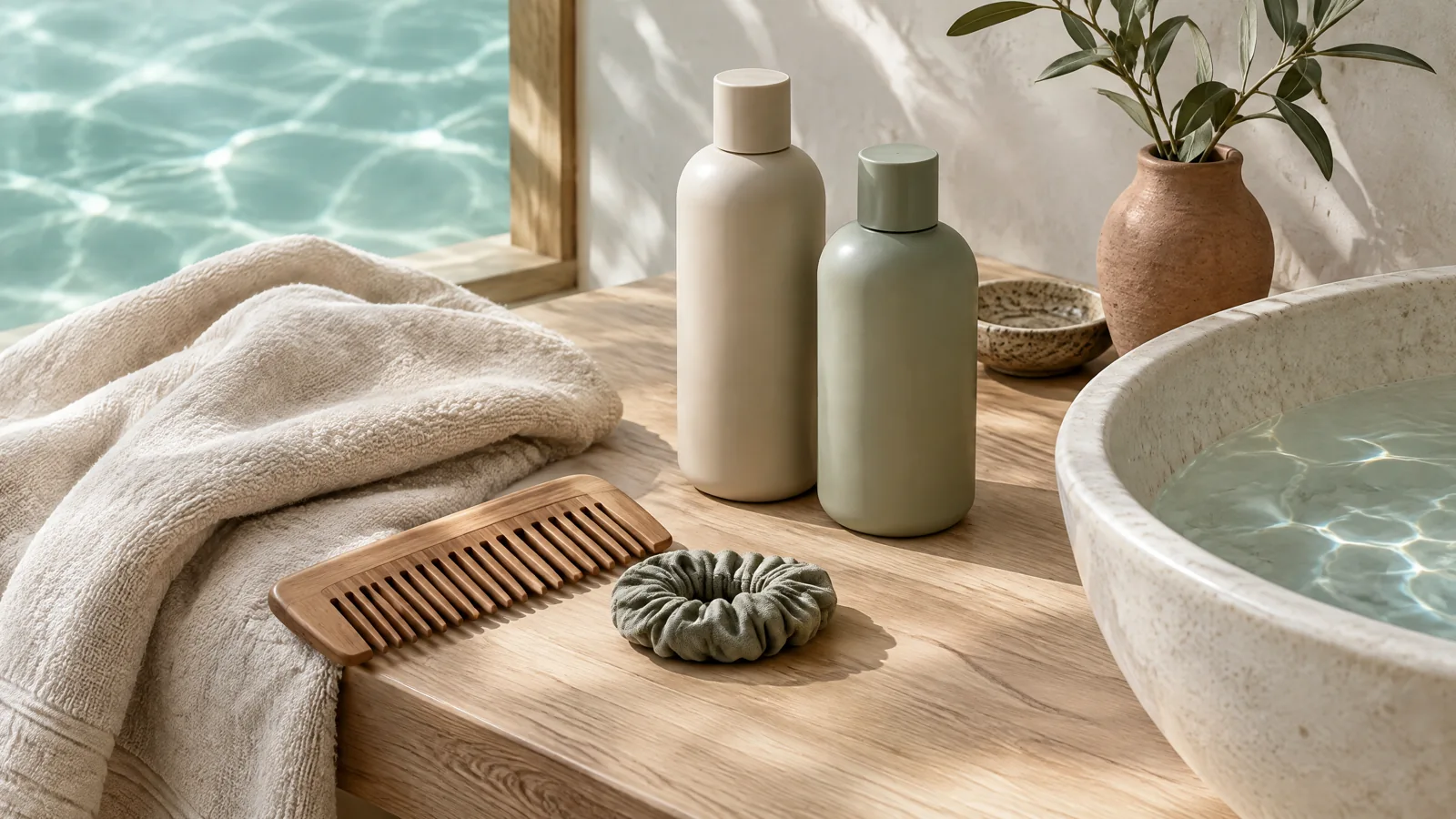
Ask about washing and changing facilities before planning the rest of the day. A meeting point, boat departure or named coastal area is not proof of a shower, private changing room or fixed classroom. Find out what is actually available and what personal items you need to bring. AAD recommends rinsing hair immediately after pool swimming, followed by a swimmers' shampoo and deep conditioner. That advice makes access to fresh water a relevant planning question, but it does not establish a guaranteed colour-preservation routine or a rule for every scalp condition. [3]
Use Canvas Blend's post-colour hair-care guide to discuss a manageable routine for your specific colour and hair condition. AAD advises absorbing water with a towel rather than rubbing hair, and avoiding tightly pulled hairstyles; its detangling advice differs for straight hair and textured hair or tight curls. Keep the routine gentle and practical instead of packing several unfamiliar products. These are hair-care considerations, not diving-equipment instructions. Ask the instructor about suitable hair containment and actual mask or hood fit rather than improvising around a photograph. [3]
Pool exposure and a sea outing are not interchangeable, so do not extend pool-specific guidance into a promise about salt water. If the look of your colour is a concern, Canvas Blend's hair-colour fading guide can help you explain what has changed to your colourist. Build enough time into the journey home for the care you have agreed. Never apply conditioner, oil or petroleum jelly to a diving mask, equipment or a wig attachment as a workaround. A rushed evening styling appointment is also worth reconsidering if it leaves no time to wash and change.
06
What should a quotation include beyond the headline fee?
Use the scuba diving course price Hong Kong page as a starting point for a course-specific enquiry, not as a substitute for a written quotation. Identify the route first, then ask about materials, equipment, venue or boat arrangements and certification administration. PADI likewise recommends asking about these inclusions, additional charges and the number of students when comparing course costs. Two totals are not comparable if one buys an introductory experience and the other covers a certification pathway. This guide deliberately avoids numeric prices because your decision needs the actual proposed package. [1]
Count costs that belong to your own calendar as well. Travel across several dates, time away from work and any optional personal purchases may change which format is manageable. Hair appointments are a separate choice, not a compulsory part of learning to dive. Canvas Blend's guide to how often to colour your hair can support a discussion about maintenance expectations before you commit to a look that demands more appointments than you want. Do not treat every water session as a reason to book another colour service.
For DiveHarbour, all paid course and activity fees are non-refundable. Make-up sessions are available only under the applicable written terms; a replacement date is not guaranteed. Ask how those terms apply to attendance issues, incomplete requirements or operational changes before paying. Then consider whether you can accept the commitment without relying on a hoped-for date change. A weather-dependent plan does not justify proceeding in unsuitable conditions, and an expensive booking must never become pressure to conceal a medical concern or participate when unwell. [2]

07
How can you turn these priorities into one useful decision?
Compare confirmed answers against your original goal and constraint, rather than awarding points for every attractive feature. If certification is the goal, an enjoyable introduction alone does not achieve it. If uncertain interest is the main issue, buying a larger course simply because friends are joining may be premature. If your calendar leaves no room for required preparation, a later start can be a stronger choice than a hurried booking. There is no need to decide the whole future of your diving hobby in the first enquiry.
Return to the two hypothetical learners. The regular-hours learner might choose a confirmed certification plan with enough study time and clear language support. The shift worker might first ask about a supervised introductory format and clarify attendance before committing further. Neither outcome is a real recommendation for an assessed individual, and neither implies current availability. The hair-colour appointment can then be planned around reliable information rather than an imagined schedule. This is what personal fit looks like: different choices that respect the same need for clear training and honest participation.
Send one concise message that contains the details below, then wait for a specific reply. If an important answer remains unclear, ask again before payment rather than filling the gap with an assumption. Keep the confirmed quotation, meeting arrangements and terms together so you can check them without searching through multiple messages. The final decision should feel explainable in ordinary language: you understand what you are booking, can attend the required learning, know what still depends on confirmation and have a practical plan for the rest of the day.
- State whether you are new, previously introduced to scuba, certified or returning after a gap, and describe your goal.
- Give preferred dates and genuine attendance limits, including work shifts and any fixed travel commitments.
- Describe swimming comfort, preferred learning language and relevant equipment or accessibility questions without overstating your experience.
- Ask for the required learning sequence, supervision arrangements, current medical paperwork and any additional-practice policy.
- Request written inclusions, meeting points, washing and changing information, and non-refundable payment and make-up terms.
What else should you know about water activities, hair care and planning?
Should I choose the school with the shortest course timetable?
Not on speed alone. Compare required preparation, supervised learning and assessment, plus how additional practice is handled. PADI describes its Open Water course as performance based, so an advertised duration is not an individual completion guarantee. [1]
Is a supervised introductory experience the same as certification?
No. An introduction can help you explore interest, while a certification route involves its specified learning and assessment requirements. Ask for the exact course or experience name, agency where applicable, prerequisites and scope before comparing packages.
Can I dive a fixed number of days after colouring my hair?
There is no universal interval that guarantees suitability for every treatment and scalp. Discuss your colour history and proposed water sessions with your colourist, tell the instructor about relevant concerns, and seek qualified medical advice for symptoms or screening questions.
Does a swimming cap solve hair-care and equipment concerns?
AAD recommends a cap for pool swimming, but that does not mean it is appropriate for your diving session. Confirm anything worn with diving equipment with the instructor, including its effect on fit. A cap cannot guarantee dry hair, retained colour or freedom from irritation. [3]
Can an instructor give me medical clearance if I am unsure about the form?
Individual medical clearance belongs to qualified medical professionals. Use the currently required questionnaire, answer honestly and obtain the review it calls for. Do not ask an instructor or a salon to diagnose a condition or override the screening process. [2]
Will DiveHarbour refund my fees if my schedule changes?
All paid course and activity fees are non-refundable. Make-up sessions are only available under the applicable written terms, and no replacement date is guaranteed. Read the specific attendance, operational and payment conditions before committing.
What is the next step for travel and hair-care planning?
Choose the next step by resolving the biggest uncertainty first: your interest, learning support, attendance or medical paperwork. Request one written plan that connects the course requirements with the dates and inclusions you can actually accept. Then coordinate any colour appointment and after-session care around that confirmed plan. You do not need the fastest course, an elaborate product kit or a dramatic new look to begin. You need a route you understand, honest communication about your present needs and enough space in the day to learn without rushing.
From root touch-ups to pre-wedding colour planning, use hair colour price Hong Kong as an initial reference and discuss your current hair condition before confirming the service.
Sources and editorial notes
- [1] PADI — Become a Certified Scuba Diver FAQs
- [2] Divers Alert Network — Honesty and the Dive Medical Form
- [3] American Academy of Dermatology — How to stop damaging your hair
This AI-assisted Canvas Blend editorial guide is not a real-client or travel record and is not an independent review. Canvas Blend and DiveHarbour share the same owner; resource links are not independent third-party endorsements. It was not written or reviewed by Vit So in the capacity of a diving instructor; his salon experience does not establish diving-teaching qualifications. It covers water activities, hair care and travel/course planning, not diving instruction, emergency procedures or personal medical clearance. Ask a qualified medical professional about individual medical fitness, and obtain technical training from a qualified instructor. Confirm current external course fees, dates, terms and eligibility directly with DiveHarbour. DiveHarbour’s written terms provide no refunds; only eligible make-up arrangements may be considered under those written terms, with no guaranteed make-up session. Canvas Blend salon enquiries and DiveHarbour external course enquiries, payments and bookings must be handled separately.
Canvas Blend editorial content with AI assistance. Canvas Blend is a hair-colour salon and shares ownership with DiveHarbour; this article is not an independent review. No diving-instructor or medical-review credential is claimed for the author or Vit So. This is planning information, not technical training or personal medical advice. Scenarios are hypothetical, and any accompanying AI illustration is not a real facility or course photograph. Confirm services, prerequisites, dates, venues, availability, inclusions and written terms directly. All paid DiveHarbour course and activity fees are non-refundable; make-up sessions are only available under the applicable written terms.
More Water Activity and Hair-Care Guides
Water, Travel & Hair CareHow to choose a scuba diving course Hong Kong around your routine
Choose a Hong Kong scuba learning route around work, study time, water sessions and hair-colour care, with practical comparisons and questions to settle before booking.
Water, Travel & Hair CareCompare scuba diving course price Hong Kong beyond the headline
Compare Hong Kong scuba course quotes by training scope, equipment, travel time and written terms, with practical budgeting for water days and coloured hair.
Water, Travel & Hair CareHow to book a scuba diving course in Hong Kong without rushing
Plan a Hong Kong scuba course around your learning needs, written booking evidence, travel commitments and realistic post-swim hair care before paying.