Water Activities × Hair Care × Travel Planning
PADI Bubblemaker Hong Kong for kids: keep comfort and consent first
Browse original Traditional Chinese water activity and hair-care guides →
Begin with whether your child genuinely wants to try, not whether the family has a free afternoon. PADI describes Bubblemaker as a directly supervised shallow-water introduction for children aged eight and over who are comfortable in water and have parental approval. Ask the operator about the actual setting, equipment fit, supervision and how a child can pause or stop before paying. Hair care should make the day easier, never override equipment checks or the child's decision. [1]
A first encounter with scuba can be interesting without becoming a test of bravery. For a child, success might mean asking the instructor a question, becoming comfortable with unfamiliar equipment, or deciding that today is not the right day. Parents can make room for those outcomes before any booking exists. That is more useful than promising an underwater photograph or explaining that everyone else in the family is excited. The decision belongs in a conversation involving the child, parent and appropriately qualified professional, with medical questions directed to a clinician where needed.
For Canvas Blend readers planning a pool day alongside ordinary family routines, comfort also includes the less dramatic details: a hairstyle that does not pull, time to change, and an adult's realistic expectations about freshly coloured hair. These are supporting arrangements, not diving safety checks. This guide separates them so a cosmetic concern never becomes a reason to alter equipment or pressure a child. Canvas Blend is a hair-colour salon and shares ownership with DiveHarbour; this is planning information rather than an independent assessment of a dive operator.
From root touch-ups to pre-wedding colour planning, use balayage price Hong Kong as an initial reference and discuss your current hair condition before confirming the service.
01
Does turning eight mean a child is ready for Bubblemaker?
Eight is an eligibility starting point, not a personal readiness certificate. PADI's official description requires children to be at least eight, comfortable in the water and participating with parental approval. It says no prior experience is necessary and describes first breaths underwater in water shallower than 2 metres/6 feet under direct supervision of a PADI Professional. Those conditions describe the programme; they do not promise that every eligible child will enjoy it or that shallow water removes risk. [1]
Before enquiring about PADI Bubblemaker Hong Kong for kids, describe your actual child rather than selecting the most flattering label. A child who enjoys swimming may still dislike water near the face or unfamiliar sensations around the head. Another may be curious but need extra time to understand a new adult's explanations. Give examples of what feels comfortable and what has caused hesitation, without diagnosing the cause yourself. Ask how the professional will assess suitability in the proposed setting.
DAN's expert discussion emphasises that children differ in maturity, attention and responses to stress, and that the desire to dive should come from the child rather than the parent. It also distinguishes appropriately supervised young participants from independent adult divers. Use that perspective to resist comparisons between classmates or siblings. A birthday, strong swimming result or enthusiastic older brother cannot decide this child's readiness. [2]
Share relevant health information honestly through the operator's requested process. If a questionnaire or concern requires medical evaluation, let the appropriate clinician decide that question; an online article cannot clear a child. Equally, medical approval where required does not oblige an unwilling child to participate. Ask the instructor about practical suitability and keep willingness as a separate, ongoing conversation.
02
How can parents make consent meaningful rather than ceremonial?
Parental approval is a programme requirement, but a parent's signature should not be treated as the child's enthusiasm. [1] Ask what interests them and what they imagine will happen. A child who expects to chase fish may have a different picture from a controlled introductory session. Explain the proposed experience in simple, truthful language supplied by the operator, without teaching underwater techniques yourself. Make it clear that asking questions is welcome and that changing their mind will not disappoint you.
Consider this hypothetical planning scenario, not a real customer account: an eight-year-old likes the idea of bubbles but becomes quiet when equipment is mentioned. Their parent has already organised a celebratory lunch. Instead of saying, 'You will love it once you start,' the parent asks whether the child wants to hear more from the instructor or leave the idea for another time. Lunch remains a family occasion either way. Separating participation from the celebration removes a reason to hide uncertainty.
Ask the professional how the child will communicate a wish to pause, who will respond, and what ending participation looks like in that setting. The instructor should explain the actual communication arrangements and manage the activity. Parents should not invent underwater signals or rehearse a home scuba lesson. At the venue, avoid bargaining for one more attempt, filming a reluctant child for encouragement, or praising only the child who completes everything. Agree that a clear request to stop will be respected.
Listening does not mean leaving the child to make every technical decision. Adults retain responsibility for suitable arrangements, supervision and honest disclosure. A child's eagerness cannot override an instructor's decision that participation is inappropriate. Conversely, an adult's reassurance cannot convert unwillingness into consent. Keep both boundaries visible: the professional sets the activity's limits, and the child is not required to use all the offered time.
03
Can a family enjoy the day without everyone doing the same activity?
A shared outing need not mean a shared underwater programme. One adult may want to try scuba, another may prefer to observe where permitted, and a younger sibling may need a different plan entirely. When considering a family scuba diving experience Hong Kong, send each person's age, experience and expectations separately. Ask whether the proposed arrangements genuinely accommodate those differences. Do not assume that an adult activity becomes suitable for a child because the booking is private or described as family-friendly.
Choose the family goal before the format. If the goal is to let one child explore a new interest, adults may need to spend more time waiting than participating. If the goal is a group adventure, an age-appropriate alternative may fit better. Neither choice is inferior, but confusing them can create pressure: a child may feel responsible for a parent missing their own activity. Decide who will remain available for the child and who will manage other relatives if plans change.
Use the comparison below to identify questions, not to select a programme without professional input. Actual ages, venue access, available formats and supervision need confirmation. A parent observing from the side is not a substitute for required professional supervision. DAN's discussion warns against treating children as small adults and stresses supervision and suitable equipment; that principle remains relevant even when an adult relative is an experienced diver. [2]
Also ask whether the child can understand the briefing language comfortably. A parent may help describe preferences beforehand, but translating complex instructions during an activity should not be improvised as the supervision plan. Allow enough arrival time for questions and changing without placing another paid attraction immediately afterwards. A flexible afternoon is useful only if the operator's actual arrangements and the family's transport make it practical.
If you are planning a change of colour, learn about hair colour Hong Kong before your consultation and consider the techniques, tones and upkeep that suit your routine.
| Possible choice | What it may support | Trade-off to clarify |
|---|---|---|
| Child-focused Bubblemaker enquiry | A curious eligible child exploring scuba under direct professional supervision | Exact setting, suitability assessment, equipment sizes and stopping arrangements |
| Different activities for adults and children | Individual interests without forcing one pace | Separate supervision, parent availability and whether the venue permits observation |
| A non-scuba family outing | Togetherness when a child does not want equipment-based participation | The alternative still needs suitable supervision and its own activity checks |
| Wait and revisit the idea | Time for the child to develop interest or water comfort | No fixed deadline or guarantee that a later date will suit |
04
Where does hair comfort end and equipment fitting begin?
Hair can be a genuine comfort issue without becoming a technical problem for parents to solve. Tell the instructor if the child dislikes tight styles, has tenderness around the scalp, or becomes upset when hair catches during ordinary dressing. A familiar, comfortable arrangement may help the child arrive settled, but the professional must confirm how it works with the actual equipment. Do not tighten a style repeatedly to persuade a child to accept discomfort, and do not decide that a fit is safe from a photograph.
Bring a spare soft hair tie if the child normally uses one, then ask before changing anything that affects equipment placement. Avoid elaborate accessories that need constant adjustment. The useful distinction is simple: parents can describe a preference and help with ordinary grooming; the professional checks the activity equipment. If the child reports pain, pressure or distress, tell the instructor promptly and let them manage the next decision. Do not attempt an equipment modification to protect a hairstyle.
For an accompanying adult with an easily irritated scalp, Canvas Blend's sensitive-scalp hair-colour guide can help prepare a separate salon conversation. It is not a pool participation assessment and should not be applied to a child's symptoms as a diagnosis. New or persistent irritation deserves appropriate professional advice. A protective cosmetic product does not eliminate allergy risk, and a salon appointment cannot establish medical fitness for scuba.
Keep products away from masks, straps and other equipment. Do not put oil, petroleum jelly or conditioner on a mask or use cosmetics to solve equipment discomfort. If a hairpiece or attachment is involved for any family member, disclose it and ask about the activity boundary rather than improvising adhesive or fit changes. Appearance is optional; a comfortable, professionally checked arrangement is not something to trade away for a better picture.
05
What should the family pack for comfort and uncomplicated hair care?
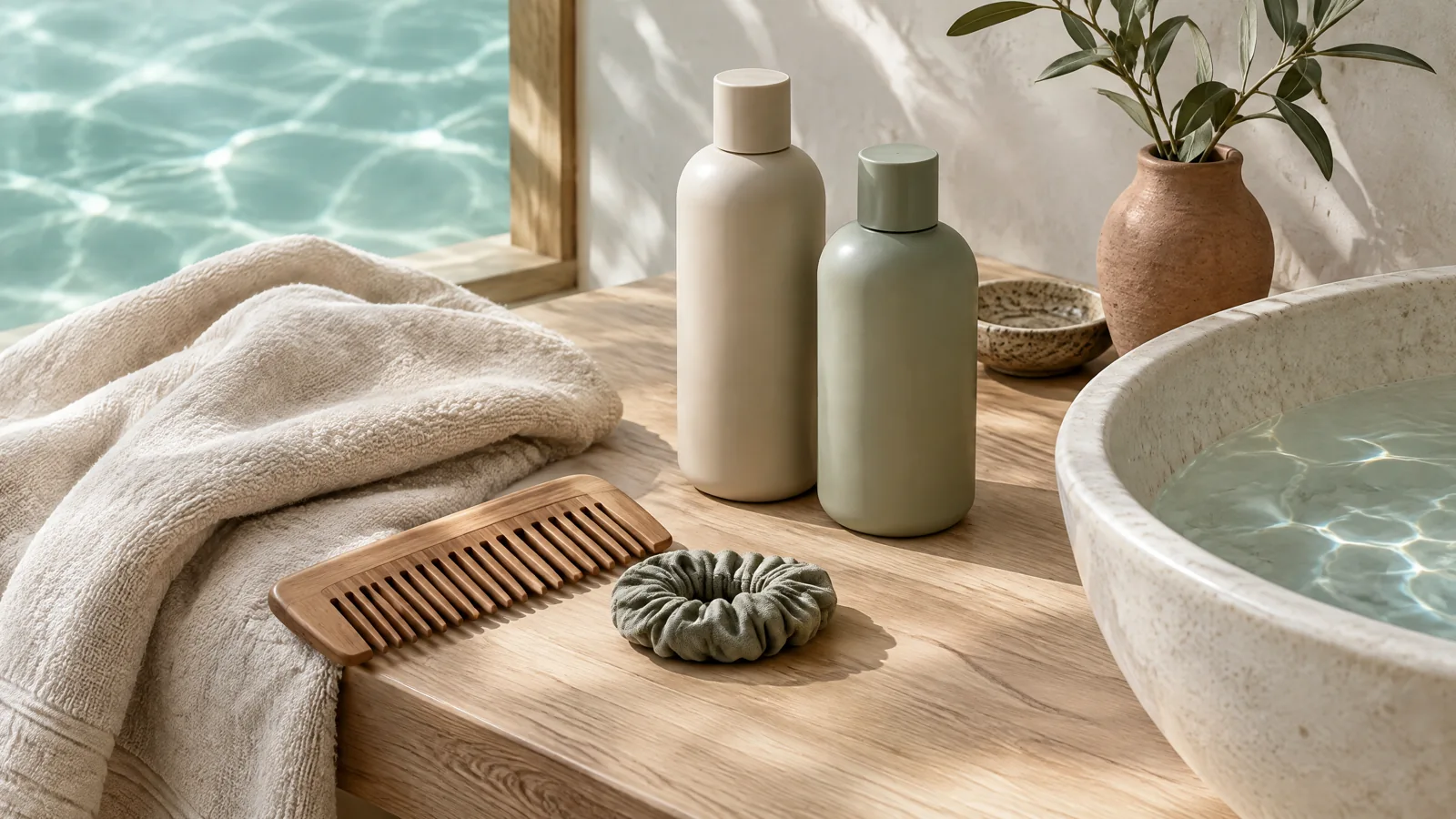
Ask what the venue supplies before packing. A towel, comfortable swimwear, dry clothes and drinking water are sensible starting points, alongside any forms the operator requests. Confirm shower access and where belongings can be stored. A small, familiar kit is usually more useful than many unfamiliar products that need explaining to a tired child. Keep the changing plan easy, and ask how a parent can assist within the venue's privacy and access rules.
For hair after pool exposure, the American Academy of Dermatology recommends rinsing immediately after swimming, then washing with a swimmers' shampoo and following with conditioning. [3] Choose products suitable for the person using them and follow their directions; adult colour-care products are not automatically appropriate for children. The priority is an unhurried wash and change, not a complicated treatment at poolside. Canvas Blend's post-colour hair-care guide offers optional reading for a participating parent's own routine, separate from the child's needs.
If a parent has recently lightened their hair, discuss the whole swimming schedule with their colourist instead of asking for a universal number of days to wait. AAD notes that bleached blond or highlighted hair is more vulnerable to sun and chlorine damage and advises considering colour timing before a sun-and-pool holiday. [3] The explanation in does bleaching damage hair? can help frame that adult consultation. Neither a waiting period nor a conditioner guarantees protection, and these considerations do not justify cosmetic colouring of a child.
Parents worried about shade changes can use the hair-colour fading solutions guide to separate ongoing maintenance questions from today's family activity. Avoid demanding that a child finish quickly because your own hair is wet or an appointment follows. Arrange your washing time independently. AAD's ordinary pool advice also discusses swim caps, but that is not a recommendation to add one to scuba equipment without the instructor confirming the actual arrangement. [3]
- Confirm the venue, changing facilities, shower access and permitted parent observation.
- Bring requested paperwork, a towel, dry clothing, drinking water and familiar personal-care essentials.
- Share hair-pulling sensitivity or scalp discomfort before equipment fitting.
- Keep all cosmetic products separate from masks and activity equipment.
- Leave time afterwards for washing, changing and a calm journey home.
06
What needs to be clear before the family pays?
Request a written description of the specific proposed activity rather than relying on a general programme title. Confirm the child's age and consent requirements, the venue and meeting point, direct supervision arrangements, equipment sizing and expected schedule. Ask who will brief the child, whether a parent must remain present, and how the team handles a child who declines or ends participation. These questions concern an actual booking; a location page alone does not establish a permanent classroom or branch.
Ask for the total charge and what it includes, without assuming that an introductory children's session shares an adult package's inclusions. Clarify transport, venue access and any separate costs before committing. DiveHarbour states that all paid course and activity fees are non-refundable. Make-up sessions are possible only under the applicable written terms, and a replacement date is not guaranteed. Request the weather and operational policy too, including how changes are communicated. Keep the written confirmation rather than relying on a reassuring verbal summary.
Financial clarity protects the child's freedom to stop because it moves the difficult money conversation away from the water. A parent may reasonably dislike losing a paid opportunity, but that concern should be considered before purchase, not presented to the child as a debt to repay by continuing. Do not book unless you can accept the stated financial terms alongside the possibility that participation will not proceed as hoped. Ask any unresolved policy question before paying.
If the family is visiting Hong Kong, share relevant travel commitments with the operator and seek appropriate professional guidance for the itinerary. Do not use this article to calculate an individual post-dive flight interval. Likewise, a preferred holiday date does not establish availability or suitable conditions. Keep an alternative family plan, but do not assume a weather-related change creates a refund, automatic credit or guaranteed make-up session.

07
How should families decide what comes after the first introduction?
Afterwards, ask what the child enjoyed and what felt unfamiliar before asking whether they want another session. Listen to the answer without turning it into an assessment. 'I liked watching' and 'I do not want to try again' are useful responses. If they stopped, describe that accurately rather than calling it failure. Let the instructor explain any practical observations, and seek appropriate medical care for symptoms that need assessment; do not diagnose them as ordinary nerves.
An adult who becomes interested through the family day can read about try scuba diving Hong Kong and make their own enquiry. That separates the parent's curiosity from the child's pace. Share the adult's water experience and health questions independently, and confirm the actual introductory format. A general first-time scuba option should not be assumed to apply to an eight-year-old, and a child's introduction does not confer independent-diving certification.
For families considering regular pool activities, plan maintenance around the routine rather than repeatedly moving colour appointments in response to one outing. An adult can bring the swim schedule to a colour consultation and use Canvas Blend's how often to colour hair guide to prepare questions about their own goals. This is a personal-care decision, not a reason to restrict a child's chosen activity or a promise that a particular colouring interval prevents damage.
If the child remains interested, ask the professional what age-appropriate options might follow and what each would require. Keep a new decision genuinely new: enjoyment today does not commit the child to certification, another date or a family tradition. If they prefer another activity, support that choice. The most useful result is an honest understanding of their interest and comfort, with no need to turn a brief introduction into a larger purchase.
What else should you know about water activities, hair care and planning?
Is Bubblemaker available to children younger than eight?
PADI's official Bubblemaker description requires children to be at least eight. Ask about a different age-appropriate activity rather than treating enthusiasm or parental permission as an exception to that requirement. Actual arrangements still need confirmation. [1]
Does a confident swimmer automatically qualify?
No. PADI requires water comfort, but willingness, equipment fit and the professional's assessment also matter. Swimming confidence does not settle medical questions or guarantee comfort with scuba equipment. [1] [2]
What if my child agrees at home but says no at the venue?
Tell the instructor and respect the child's decision. Do not bargain for participation because the session has been paid for. DiveHarbour's paid fees are non-refundable; any make-up arrangement depends only on the written terms and is not guaranteed.
Can I supervise my child because I am already a diver?
Your own experience does not replace Bubblemaker's required direct PADI Professional supervision. Ask about the parent's role and permitted observation in the actual venue; do not assume that an adult certification changes programme boundaries. [1]
Should we put conditioner on the mask to avoid pulling hair?
No. Keep conditioner, oils and petroleum jelly away from masks and other equipment. Describe the discomfort to the instructor and let them confirm the fitting arrangement. Ordinary hair care and equipment checks are separate responsibilities.
How long after colouring can a parent join a pool activity?
There is no universal waiting period in this guide. Discuss your hair's condition, scalp concerns, products and planned exposure with the appropriate professional. AAD advises considering colour timing before sun-and-pool holidays, particularly for bleached blond or highlighted hair; this is not medical clearance or a guarantee against fading. [3]
What is the next step for travel and hair-care planning?
Start with one unpressured conversation: does your child want to learn more, and what would help them feel heard? If interest is genuine, send the operator their age, water comfort, relevant concerns and preferred timing. Request the actual supervision plan, equipment arrangements and written financial terms before committing. Leave medical decisions to the appropriate clinician and all activity instruction to the qualified professional.
Then organise the supporting details around that decision. Separate adults' participation where necessary, keep hair care away from equipment, and allow time to wash and change without rushing. A child-centred introduction is not measured by how much of the schedule gets used. It leaves the child able to say yes, pause or decline honestly, while the adults understand the practical commitments they have chosen.
After browsing PMQ or Hollywood Road, readers can use the local overview of hair salon Sheung Wan to coordinate a colour consultation with shopping, work, or weekend plans.
Sources and editorial notes
- [1] PADI Bubblemaker Program & Seal Team Course
- [2] DAN Alert Diver: Children and Diving
- [3] American Academy of Dermatology: Must-try summer hair care
This AI-assisted Canvas Blend editorial guide is not a real-client or travel record and is not an independent review. Canvas Blend and DiveHarbour share the same owner; resource links are not independent third-party endorsements. It was not written or reviewed by Vit So in the capacity of a diving instructor; his salon experience does not establish diving-teaching qualifications. It covers water activities, hair care and travel/course planning, not diving instruction, emergency procedures or personal medical clearance. Ask a qualified medical professional about individual medical fitness, and obtain technical training from a qualified instructor. Confirm current external course fees, dates, terms and eligibility directly with DiveHarbour. DiveHarbour’s written terms provide no refunds; only eligible make-up arrangements may be considered under those written terms, with no guaranteed make-up session. Canvas Blend salon enquiries and DiveHarbour external course enquiries, payments and bookings must be handled separately.
Canvas Blend editorial / AI-assisted. Canvas Blend is a hair-colour salon and shares ownership with DiveHarbour; this is not an independent review, instructor advice or medical advice. No instructor authorship or review is claimed. Confirm current services, suitability, venues and written booking terms directly. All paid DiveHarbour fees are non-refundable; make-up sessions are only available under the applicable written terms. Any accompanying AI-created illustration is illustrative, not a photograph of an actual facility.
More Water Activity and Hair-Care Guides
Water, Travel & Hair CareJunior Open Water Diver course Hong Kong: plan a family learning week
Plan a realistic junior diving learning week around your child's readiness, family responsibilities, weather flexibility and practical swimming hair care.
Water, Travel & Hair CareFamily scuba diving experience Hong Kong: choose separate goals
Plan a family scuba day around individual goals, junior readiness, flexible schedules and practical hair-colour care, without making everyone follow one course.
 Water, Travel & Hair Care
PADI Divemaster training Hong Kong: Compare Mentoring Commitments
Compare Divemaster mentoring by supervision, useful feedback, realistic scheduling and written commitments, while planning repeated water sessions around work and hair care.